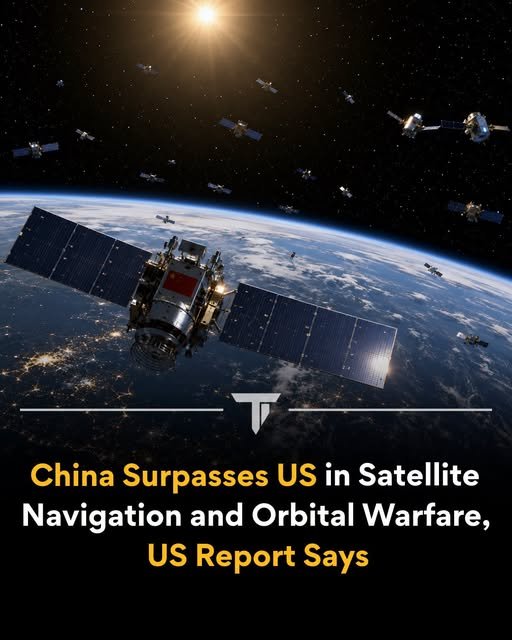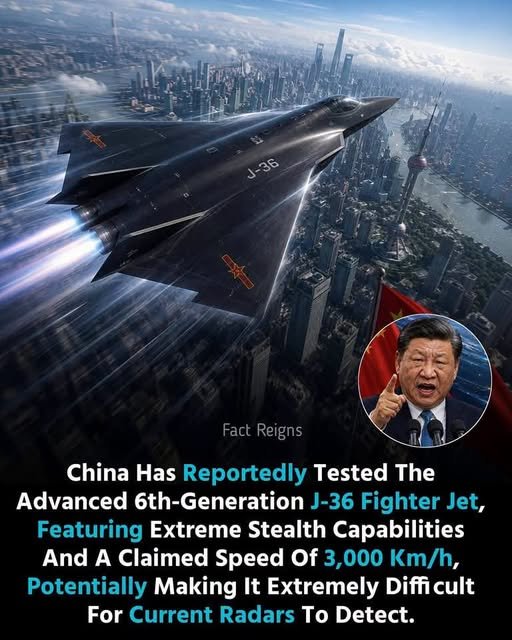

A newly released photograph in a US intelligence report has offered a rare glimpse of what is widely believed to be China’s secret Shenlong spaceplane in orbit, showing its payload bay doors open.
In the image released by the US Defence Intelligence Agency (DIA) on October 26, a lone spacecraft is visible. Neither the DIA nor Beijing has said whether it is a Shenlong spaceplane.
The photo raises a question: how many reusable orbital vehicles like Shenlong would be needed for a rapid global strike?
The answer is a fleet comprising just 40 spaceplanes, according to a new study.
In the study, Chinese researchers proposed an orbital constellation that could allow uncrewed spacecraft to begin descending towards any location on Earth after a “maximum wait” of 2½ minutes.
And if the target were located in most of the world’s populated regions, it would take only about a minute.
The findings were based entirely on computer simulations, and the one-to-two-minute figures refer to the maximum wait for a suitable return opportunity rather than the time needed to reach a destination.
The findings could have implications for rapid global transport and potential space-based military strikes, allowing vehicles already stationed in orbit to engage distant targets almost immediately after receiving an order, leaving little time for a target to detect or respond.
The research was conducted by Du Chongrui and his team at Northwestern Polytechnical University’s school of astronautics in Xian, an institution under US sanctions.
The study was published online on October 30 in the peer-reviewed Chinese journal Acta Aeronautica et Astronautica Sinica, just four days after the American intelligence report offered a rare look at China’s reusable spacecraft programme.
The photograph appeared in the DIA’s “Challenges to Security in Space” report and was taken on May 28, 2024, by the WorldView-3 commercial imaging satellite operated by Maxar Technologies, now Vantor, from less than 90km (56 miles) away.
It shows a delta-wing spacecraft with an open cargo bay and equipment mounted at its rear.
The spacecraft resembles the US military’s Boeing X-37B, an uncrewed reusable spaceplane that can stay in orbit for extended periods before returning to Earth for a runway landing.
China has conducted four missions involving its experimental reusable spacecraft since 2020, most recently launching one in February, although Chinese authorities have disclosed few details about its design or capabilities.
According to the DIA report, the spacecraft appeared to manoeuvre alongside a companion satellite during its second mission in 2022-23 and released and interacted with an object during its third mission in 2023-24.
Such operations could support satellite deployment, inspection and servicing but might also have military applications, including intelligence gathering and interference with other spacecraft.
Beijing has described its reusable spacecraft programme as an effort to make access to space more convenient and affordable.
While the Shenlong programme has so far focused on testing individual spacecraft, the new study explored how an entire fleet of reusable orbital vehicles could be positioned to minimise delays in reaching destinations worldwide.
Unlike conventional communications or surveillance satellites, which generally need only to pass over designated areas, these vehicles must occupy suitable orbital positions from which they can descend and manoeuvre towards ground destinations.
The researchers described such spacecraft as capable of “rapidly departing orbit and reaching their destinations with precision”.
Unlike rockets launched from Earth, returning orbital vehicles must first leave their orbits, descend into the atmosphere and use aerodynamic lift to glide towards their destinations.
Their flight paths also differ from the largely ballistic trajectories of traditional ballistic missiles, although some modern missile warheads can manoeuvre during re-entry.
For the simulation, the researchers assumed 40 vehicles operating in circular orbits 400km above Earth, using a reference hypersonic glide vehicle model known as CAV-H rather than Shenlong’s actual specifications.
Each vehicle was assumed to descend to an altitude of 100km before beginning its atmospheric glide, with a maximum longitudinal range of about 10,348km and a lateral manoeuvring distance of 2,485km.
To determine which areas each vehicle could reach, the team developed a mathematical model accounting for orbital transfer time, atmospheric gliding capability and Earth’s rotation.
They then used an artificial intelligence technique known as proximal policy optimisation, improved with a curiosity-driven exploration mechanism, to adjust orbital inclination, the separation between orbital planes and the positions of individual spacecraft.
Rather than adopting the evenly spaced orbital planes of conventional “Walker” satellite constellations, the algorithm identified an uneven arrangement that reduced the longest gaps between successive opportunities to reach a particular location.
In a 24-hour simulation, the optimised constellation achieved a maximum global revisit interval of about 2½ minutes, compared with 8.6 minutes for the best-performing conventional Walker configuration tested.
“Its coverage uniformity is markedly better than that of traditional Walker configurations,” Du and his colleagues wrote.
When the optimisation focused on regions between 60 degrees north and south, home to most of the world’s population, the maximum interval fell to one minute, a reported reduction of 58.8 per cent compared with the global design.
The improvement came at the expense of some coverage near the poles, showing how the constellation could be configured to prioritise different geographical regions.
For potential military applications, the advantage would lie in keeping manoeuvrable vehicles stationed in orbit, ready to descend towards designated targets after receiving orders.
Unlike ballistic missiles launched from ground-based facilities, orbital vehicles could potentially approach targets from different directions and manoeuvre during atmospheric flight, posing more challenges for missile warning and defence systems.
The idea of delivering weapons from orbit is not new, dating back to the Cold War when the Soviet Union developed a fractional orbital bombardment system designed to approach targets along trajectories that could complicate early-warning arrangements.
In 2021, reports that China had tested a fractional orbital bombardment-type system combined with a hypersonic glide vehicle raised concerns in Washington about the military applications of such technology.
Beijing described the activity as a reusable spacecraft technology test.
The US has also continued developing reusable orbital vehicles, with its uncrewed X-37B launching its eighth mission in August last year, reflecting sustained American interest in spacecraft capable of orbital manoeuvres and controlled returns.
The Chinese researchers highlighted potential applications in emergency disaster response and rapid transport, although their proposed constellation could also have military uses.
The South China Morning Post has contacted Du for comment.
Author: Saikat Bhattacharya