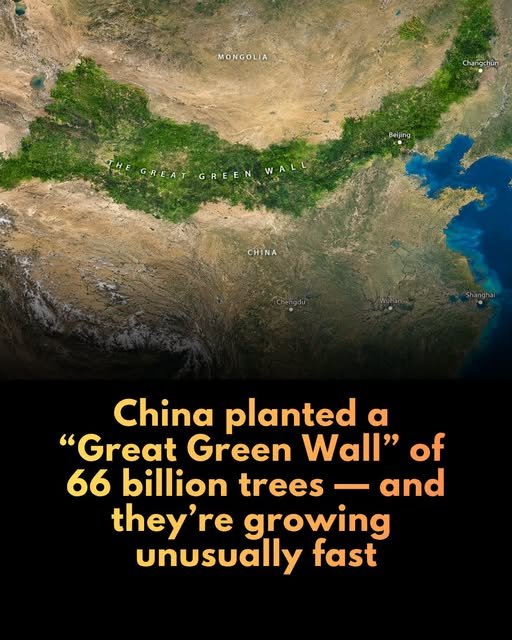






For nearly five decades, China has been cultivating the world's largest reforestation initiative, the 'Great Green Wall,' to halt the spread of the Gobi and Taklamakan deserts. A new study reveals a surprising trend: these 66 billion planted trees are expanding their leaf area 66% faster than nearby natural forests.
While younger, human-managed trees naturally grow quicker, researchers found that even after adjusting for age and local growing conditions, the planted forests still grew 4.6% faster than their natural counterparts.
Scientists believe this boost occurs because these younger forests respond more aggressively to rising carbon dioxide levels in Earth's atmosphere.
However, this rapid growth comes with a major catch: the advantage is temporary. The study shows that this growth surge peaks when the trees are between 30 and 40 years old, after which the acceleration begins to fade. While natural forests develop at a much slower pace, they continue to store carbon for centuries and support vastly superior biodiversity.
This means that while massive planting initiatives are an excellent short-term strategy to absorb greenhouse gases, they cannot replace the long-term ecological stability and carbon storage provided by protecting existing, ancient forests.
source: Luo, Y., Wang, Y., Wang, H., Wang, H., & Wu, J. (2026). Enhanced CO2 Response and Aging-Related Dynamics Drive a Greater Leaf Area Index Increase in China's Planted Forests in Comparison to Natural Forests. Geophysical Research Letters, 53(11).
Author: Saikat Bhattacharya