
Can 14nm process chips outperform 4nm chips in AI?
DFSX showcased how its DF1000 & DF2000 series chips compared to H200 & B300 chip on a per chip basis by adding in the effect of memory bandwidth. DF2000 achieves greater efficiency for wide range of tasks due to memory speed.
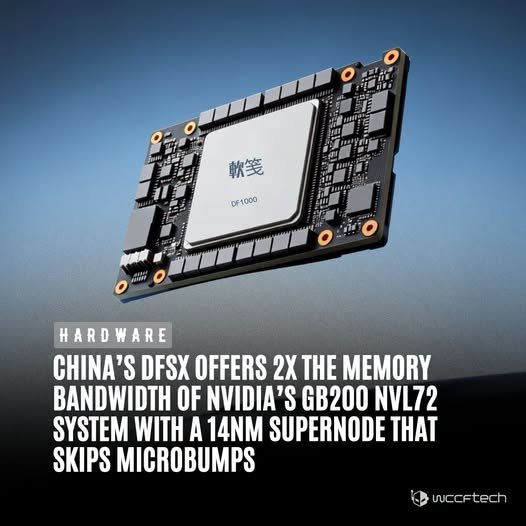
China's DFSX has introduced a 14nm SuperNode architecture that takes a different approach to AI hardware by focusing on memory bandwidth instead of advanced manufacturing nodes.
Its TY64 system uses vertically stacked compute and memory towers that eliminate microbumps, allowing it to deliver up to 960TB/s of aggregate memory bandwidth, which is claimed to be twice that of NVIDIA's GB200 NVL72.
Basically, DFSX believes that FLOPS is the wrong metric to focus on when it comes to AI workloads, with memory throughput constituting the most important metric. Do note that DF3000 chip is expected to offer a memory bandwidth of 20TB/s or 1,280TB/s when arrayed within the TY64 SuperNode. Meanwhile, NVIDIA's Vera Rubin NVL72 system offers a total memory bandwidth of 1,580TB/s, which is only 23 percent greater than what the DF3000-based TY64 SuperNode will offer.
And, we now have numbers to back up these claims. For instance, each DF2000 chip offers a bandwidth of 15TB/s. When stacked in a TY64 SuperNode format, the total memory bandwidth increases to 960TB/s. In contrast, NVIDIA's GB200 NVL72 system offers a total memory bandwidth of just 576TB/s
Author: Saikat Bhattacharya