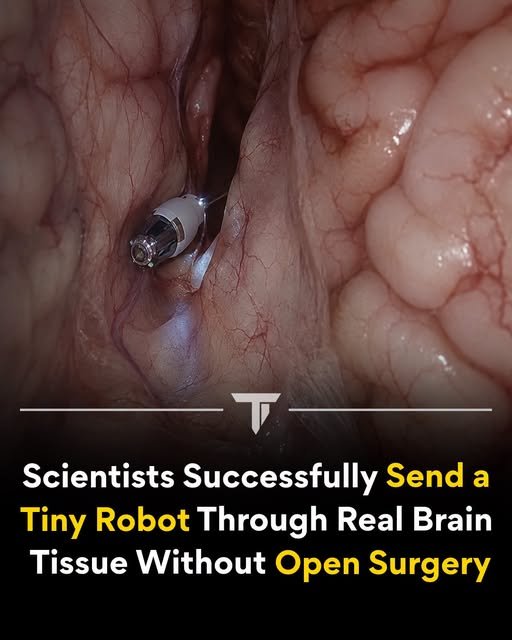






University of Twente and Radboud University Medical Center in the Netherlands have joined and successfully guided a tiny 7-millimeter, screw-shaped robot through real brain tissue using magnets outside the body.
The robot moves by spinning, while researchers control its direction with an external magnetic field.
The experiments were performed on extracted sheep brains in the laboratory. The brains were outside the animals' bodies and were not living brains. Researchers also pumped fluid through the brain's blood vessels to create conditions closer to those inside a living brain.
The robot moved through the brain tissue at about 0.2 millimeters per second. Researchers could also reverse its direction and move it back through the same path at speeds of up to 2.9 millimeters per second.
Importantly, researchers reported no visible bleeding along the path created by the robot during the experiments.
The team says the long-term goal is to develop tiny robots that could one day reach difficult areas of the brain without requiring open-skull surgery.
Such technology could potentially be used in the future to help treat strokes, brain tumors and problems with blood vessels.
However, the technology is still in the early research stage. The robot has not been tested in a living human or used to treat patients.
Source: University of Twente and Radboud University Medical Center. The study was published in the peer-reviewed journal Advanced Science.
Author: Saikat Bhattacharya