
Howard Yu
Howard Yu is professor of strategy and innovation at IMD Business School with campuses in Switzerland and Singapore.
The next phase is building factories and Chinese brands abroad as well as embedding its tech, industrial standards in global supply chains
China’s export boom is reaching its limits. The country’s next phase of growth will come not from shipping more goods abroad, but from exporting its factories, technologies and brands.
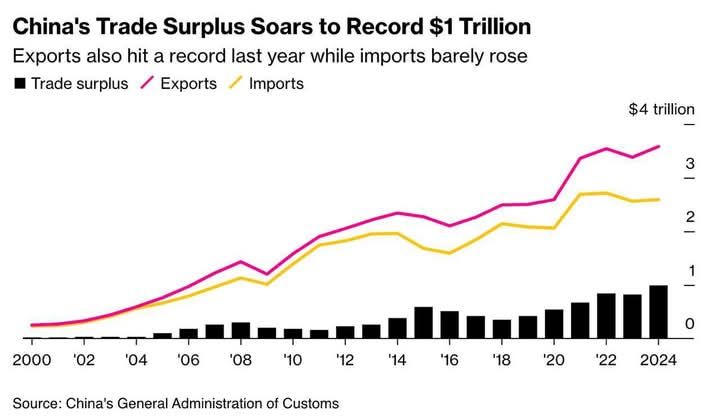
China is running up against the limits of its old model. It is obvious as the economy looks increasingly K-shaped. Weak consumer confidence and a prolonged property slump continue to sap domestic demand, forcing manufacturers to rely ever more heavily on overseas markets. Exports have become the Chinese economy’s strongest economic engine just as growth at home has faltered.
However, that approach is nearing its limits, despite China having shipped a record number of cars in June. That’s because such export growth is increasingly unwelcome in many countries. France and Germany, for instance, agreed recently to pursue tougher European Union trade safeguards, as advanced economies become less willing to absorb Chinese overcapacity.
For governments hoping tariffs will rebuild domestic industry, China’s next move will leave them disappointed. Levies can slow imports but not if China builds its factories overseas.
Recent economic data shows why China needs to change course. Its gross domestic product has expanded at the slowest rate in years, growing just 4.3 per cent year on year in the second quarter. Exports surged by 27 per cent in June, but retail sales were up just 1 per cent. Real estate investment plunged by 18 per cent in the first half.
This uneven growth reflects the K-shaped economy, and slowing growth is at the top of Beijing’s agenda. On Thursday, the Politburo promised stronger macroeconomic support and a faster pace of fiscal spending, underscoring policymakers’ determination to find new sources of growth as the old model loses momentum.
Already, the State Council has approved a new five-year plan to boost consumption, signalling that Beijing wants household spending to play a bigger role in driving growth. At present, it accounts for around 40 per cent of China’s GDP, below the average of around 54 per cent among OECD rich nations.
Much of economists’ debate has focused on whether China can sustain its export boom or revive domestic demand. That frames the challenge too narrowly. The key question is: what replaces export-led growth? The answer is to export the production system itself.
The next phase of China’s development will come from the buildout of factories overseas, expansion of Chinese brands into foreign markets and embedding of Chinese technologies and industrial standards into global supply chains. In other words, China’s next export will be the world’s factory itself.
Why? Because exporting goods eventually runs into political and economic limits. Exporting production, though, allows Chinese companies to keep expanding while earning income from what they own abroad. Increasingly, China’s overseas earnings will come from royalties, licensing fees and dividends rather than manufactured exports.
This is the transition China needs to make, and there is precedent: Japan made it four decades ago, after agreeing to voluntary restraints on car exports to the United States in 1981. Cars built in America were exempt from the quotas, however, and that drove a wave of Japanese investment in US manufacturing. Honda opened an Ohio plant in 1982, and Nissan, Toyota and Mazda followed with US plants too.
The result was a different growth model: Japan increasingly exported its production system rather than simply its products. Today, Japan makes far more from its investments abroad than its trade. Last year, net primary income, a reflection of earnings from overseas investments, hit a record high of ¥41.6 trillion (US$254 billion), while the goods trade balance remained in deficit.
China’s transition is well under way. Examples abound: Shenzhen-based BYD sold 71 per cent more cars overseas year-on-year in the first half of the year, while sales in China fell almost 40 per cent. US carmaker Ford’s battery plant in Michigan will produce cells using battery technology licensed from China’s Contemporary Amperex Technology Limited, meaning licensing income will flow to CATL’s headquarters in Ningde. Chinese carmaker Chery is producing cars at the former Nissan plant in Barcelona, Spain.
There is, however, one important difference. Unlike Japan, Beijing wants to globalise production while retaining control of the underlying technology. It is encouraging Chinese companies to build factories abroad even as it tightens export controls on battery technology and increases scrutiny of outbound investment.
China is reportedly weighing tighter export controls on advanced AI and chip technologies. It reveals Beijing’s ultimate economic strategy: it wants Chinese factories to go global while Chinese technology remains national.
Watch these two indicators over the coming decade: China’s trade surplus and its overseas investment income. The first made China the world’s factory. The second will determine whether it becomes something even more powerful: the world’s shareholder.
Author: Saikat Bhattacharya