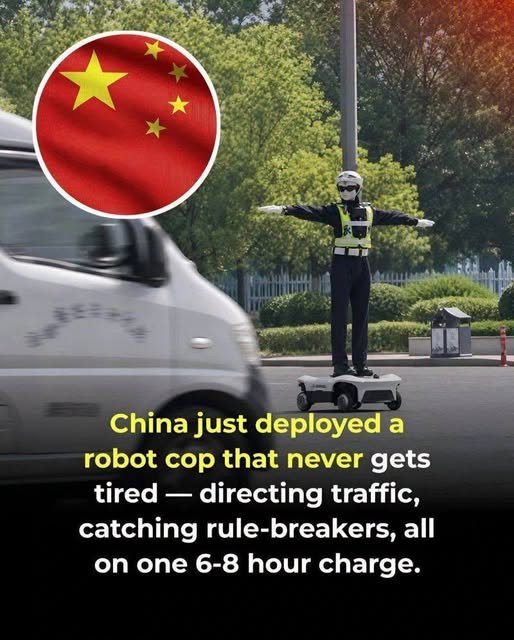






China now manufactures around 97% of the world’s humanoid robots.
And increasingly, those robots are not staying inside Chinese factories.
They are showing up on African farms, in hospitals, and deep underground in mines.
Take agriculture. With drought, land degradation, and pests threatening crops, more African countries are turning to Chinese-made drones for precision farming, according to Kenya’s Star.
The idea is simple: when water and arable land are in short supply, farmers need to use both as efficiently as possible.
But there is a bigger story behind this shift.
China’s exports to Africa are changing.
Ten years ago, it was mostly clothing and household appliances.
Then came electric vehicles and batteries.
Now, some of the more advanced products moving into African markets are robots, AI systems, and biotechnology.
And Africa is becoming one of the first places where all three are being adopted at the same time.
Healthcare is another example.
Historically, more than 70% of basic medicines used in Africa, along with almost all vaccines, have been imported.
That is beginning to change.
Chinese companies are helping build and equip local pharmaceutical factories. In Ethiopia, for example, one factory is already mass-producing IV bags and injectable medicines to meet growing local demand.
At the same time, China-Africa joint training centers are teaching medical professionals how to use robots and minimally invasive surgical equipment.
South Africa’s Independent points to another area where the technology is moving next.
The South African government is working with Chinese technology companies on AI and robotics, including a pilot project using AI-powered robotic arms for automobile painting on production lines.
And then there is mining.
South Africa’s mines include some of the deepest and most difficult underground working environments in the world. Remote drilling systems and robotic inspection equipment are being used to reduce miners’ exposure to falling rocks, extreme heat, and dust.
Training is part of the picture too.
Earlier this month, more than 20 female entrepreneurs from countries including Kenya, Egypt, and Rwanda spent several weeks in China learning how to use livestreaming and short-video platforms for e-commerce.
The goal was not simply to learn how to use the platforms, but how to make money from them.
Put all of this together, and the bigger story is not really about robots or drones.
China is exporting more than hardware to Africa.
It is also bringing in local manufacturing, technical training, and the know-how to build and operate these systems locally.
That shift is worth watching.
Robots aren’t the only Chinese technology reshaping markets outside China. Cars are too.
Last year, global electric vehicle sales surpassed 20 million for the first time.
Chinese automakers accounted for around 60% of those sales.
That number alone should be enough to worry Ford, Volkswagen, and Toyota.
But the more interesting story is not happening in Europe or the United States.
It is happening across the Global South, where Chinese electric vehicles are increasingly moving from an alternative option to the default choice.
According to the China-Global South Project, in Ethiopia, more than 140,000 electric vehicles are now on the road, and almost all of them are Chinese-made.
In Kenya, registered EVs jumped from fewer than 1,400 in 2022 to more than 39,000 in 2025 — again, largely driven by Chinese vehicles.
Southeast Asia is changing even faster.
Across the region’s six biggest markets, Chinese brands have gone from almost no presence to more than 5% of a market selling around 3.3 million vehicles a year.
In Thailand, EV sales jumped 80% last year, with Chinese brands taking more than 80% of the market.
At the latest Bangkok Motor Show, Chinese automakers also accounted for more than 60% of all vehicle bookings.
Latin America may tell the story even more clearly.
Brazil is the region’s largest auto market, and Chinese brands now account for more than 80% of its electric vehicle sales.
By the end of 2025, BYD had overtaken GM, Fiat, and Toyota to become the second-best-selling automotive brand in Brazil overall.
In Mexico, sales of Chinese-made EVs rose from just over 3,000 in 2023 to around 53,000 in 2025.
Their market share jumped from 28% to nearly 90%.
And this is no longer simply about exports.
BYD and Great Wall Motor are building factories in Brazil, turning the country itself into part of their manufacturing network.
The shift is global.
Around 75% of the world’s electric vehicles are now produced in China.
And increasingly, traditional automakers are finding themselves on the other side of the equation — licensing battery technology from Chinese companies and partnering with Chinese EV startups.
For much of the global auto industry, the question is no longer whether Chinese EVs are coming.
In many emerging markets, they are already here.
Author: Saikat Bhattacharya