


Aug 03, 2026
https://amyyyang00.substack.com/p/chinese-capitalists-are-domesticated?utm_source=share&utm_medium=android&r=4pue40&utm_id=97757_v0_s00_e0_tv2_a1dennhb76nsba&fbclid=IwY2xjawThXPlwZG9mAWV4dG4DYWVtAjEwAGJyaWQRMUIwaUhxclNHaXg0ZlJPd3RzcnRjBmFwcF9pZBAyMjIwMzkxNzg4MjAwODkyAAEex9AJ7iaiedqW14AUDECRo7DRn4cY97jPNxQtfrZozOR1mpmcixBoS_b42Do_aem_Y4xZY-9OKmyMtkp6KoKgUg&triedRedirect=true
“China has restored capitalism because it has billionaires and it allows capitalists to join the Communist Party of China (CPC).” This is perhaps the most common misconception among many Western Marxists about China. The logic behind it is simple: “capitalists should not exist in socialist countries, no need to mention in a communist party.”
Undoubtedly, class and wage labour will be abolished on day one if we build socialism in Disneyland where there is neither a birthmark of the old system nor constraints of internal material conditions and external political pressures from the imperialist West. But how about when we build socialism on earth in a semi-feudal and semi-colonial country? Can this either-or Western “empty thinking” void of dialectical materialism still work?
To develop a more holistic and objective understanding of this matter, we need to examine the following three questions:
Why does China need capitalists to build socialism?
Are Chinese capitalists a bourgeois class with political power?
What are the concrete contributions of Chinese capitalists?
Why does China need capitalists to build socialism?
This question may sound strange or even incomprehensible to many Western Marxists, as they tend to view China, a third-world country, through the lens of the first world. No one can deny that if China were a Western country in the imperialist core with highly developed productive forces and advanced technologies, China could easily build a classless society without any exploitation and even without an army and police after the people’s revolution. No Chinese people would reject this. Unfortunately, this is nothing but fantasy. So, to understand why China needs capitalists to build socialism, we have to touch the grass and analyse the material and historical conditions after 1949.
The reality that China was a backward country with an extremely low level of productive forces and almost no industries did not change just because the CPC successfully defeated the imperialist Japan and the reactionary bourgeois party Kuomintang (KMT). The material conditions after the founding of the People’s Republic of China even exacerbated the situation not only due to the 22 years of internal war and imperial war, but also because the KMT stole almost all wealth from China and destroyed many remaining industrial facilities when it escaped to Taiwan province.
Given the material conditions in China after 1949, the Chinese government led by the CPC has no privilege to ignore the question of developing productive forces and could not solely focus on the question of the relations of production, as many Marxists in wealthy Western countries tend to do. After completing the three socialist transformations in 1956 and putting the ownership of means of production (e.g., land, bank, energy, etc) into the hands of the popular class, the CPC started tackling the more challenging problem: developing productive forces.
There was no instruction on how to develop productive forces in a backward country like China with almost 90% of its population being peasants. Even the Soviet Union had a higher starting point than China. Party cadres in the CPC are also not magicians who know answers to everything automatically. Together with unpredictable external factors like natural disaster and foreign relations with the USSR, many mistakes were made, and Chinese people paid high costs for these failures in the first two decades after 1956, especially the Great Leap Forward and the Cultural Revolution.
What makes the CPC a popular Marxist party highly supported by Chinese people is not that it never makes mistakes, but that it can correct them. Thanks to the CPC’s criticism and self-criticism, the party learned lessons from past mistakes and eventually found a transitional path towards socialism, i.e, harnessing the strengths of the market and capitalists to develop productive forces and build socialism.
This path is known today as “the Reform and Opening-up”. Many Westerners may believe that this is an idea and a decision of one single person, Deng Xiaoping. But in reality, all ideas, no matter it is called “Mao’s thoughts, Deng’s theories, Xi’s thoughts”- are a result of collective efforts, and all decisions are collectively made by all Chinese people. And “the Reform and Opening up” is no exception. The path is chosen by all Chinese people with the goal of common prosperity. The idea behind it has roots in both the “New Economic Policy” of Lenin and later the thoughts of Mao Zedong on “transformation of capitalist industry and commerce (资本主义工商业改造).
As Mao said clearly in 1953 at the Enlarged Meeting of the Political Bureau of the Central Committee (在中央政治局扩大会议的讲话),
“Even if the bourgeoisie does not accept state capitalism (similar to today’s market socialism in China), there is no other path for them to choose. Even if we do not want to implement state capitalism and collaborate with the bourgeoisie, we also have no other option; we cannot confiscate their property at this stage when we still need them to develop the productive forces.”
Thus, the main reason why China needs capitalists to build socialism is to develop productive forces.
Many in the West may wonder why developing productive forces is so important for Chinese people that we are willing to make compromises to capitalists and to be exploited as wage labourers? I bet such a question will never be asked by people in the third world who have first-hand experiences of underdevelopment and poverty.
Without development of productive forces and advanced technologies, the Chinese state, regardless of how badly it wants, cannot produce enough food, build infrastructure like electricity nets, roads, highways, sewage systems, hospitals, schools, and provide free and high-quality healthcare and education. This was exactly the situation before the Reform and Opening-up, when every Chinese was equally poor and had equally no access to basic things like electricity, asphalt roads, water-flushing toilets, modern cooking stoves, modern medical equipment, schools with qualified teachers, things that are taken for granted in the imperialist West.
Are Chinese capitalists a bourgeois class with political power?
Having understood the necessity of having capitalists in China, many Westerners may still ask, “But why does the CPC allow Chinese capitalists to join the party? Does the CPC still represent the popular class (peasants and workers) when some of its party members are capitalists owning private companies?”
This concern is understandable given how political parties in the West work: regardless of the colour red, green or blue, all political parties are in reality puppets of the bourgeois ruling class, because the political power is completely in the hands of the bourgeoisie.
But this is not the case in China. As stated clearly in the “three represents”, the CPC represents “the fundamental interests of the overwhelming majority of the people ( 最广大人民的根本利益)”, i.e, the popular class. Although capitalists are allowed to join the party, they are nothing but a tiny minority, which is not represented by the CPC. Moreover, the political power of Chinese capitalists has been completely expropriated after the socialist transformations in 1956.
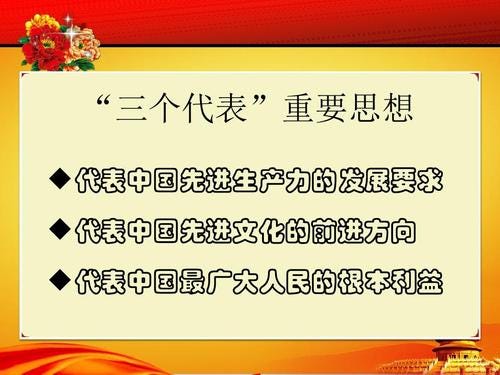
The theory of “three represents” in Chinese
Nowadays, they only have limited economic power and are under strict control by the Chinese government led by the CPC. Requirements and expectations for the Chinese capitalists are stated clearly in the “Opinion of the General Office of the CPC Central Committee and the General Office of the State Council on Improving the Modern Enterprise System with Chinese Characteristics (中共中央办公厅 国务院办公厅关于完善中国特色现代企业制度的意见)” published in 2024 , and the “Regulations of the People’s Republic of China on Privately-Owned Enterprises (中华人民共和国私营企业暂行条例)” published in 1988.
With the political power in the hands of the Chinese popular class represented by the CPC, the Chinese capitalists are often heavily punished for their misbehaviour like tax evasion, environmental violation, and bribery, while the Epstein class, despite having committed way worse crimes than those Chinese capitalists in prison, can continue their vampire lives without being punished at all.
So, why does the CPC allow capitalists to join the party?
Encouraging capitalists to join the party is, in reality, one important way to domesticate capitalists for the socialist cause and prepare the ideological ground for further transition to the higher stage of socialism.
Being a member of the CPC sounds much easier than it actually is. To join the party, one has to prove one’s loyalty to the party, communism, and the Chinese nation. The checking process can last for several years until one officially becomes a party member. After joining the party, one has to attend monthly study groups, join the regular criticism and self-criticism sessions, read study materials assigned by the party, and write reports about all activities above.
In other words, even though many capitalists in China join the party for material benefits or positive images rather than their belief in Marxism, their “capitalist brains” will be washed regularly by Marxist theories once they have joined the party. Furthermore, the social expectation towards a party member is higher than a non-party member. For example, it is expected of capitalists who have joined the party to take more social responsibilities and provide better working conditions for their workers.
In addition, allowing Chinese capitalists to join the party is an effort to maintain the class contradictions at a non-antagonistic level, to make capitalists feel more included and accepted by society.
Different from capitalists in the West with vast generational wealth, the majority of Chinese capitalists came from a peasant or working class background and became rich very recently in the past three decades. Due to this background, they felt mistreated before the rule of party membership was changed: “Why can’t we join the party but our old comrades in the factory can, just because we decided to quit our jobs and start our own business after 1978?”
Changing the rule is exactly a response to the dissatisfaction of Chinese capitalists. As stated in the quotation from Mao above, China still needs capitalists to help develop its productive forces. It is thus important for the Chinese government led by the CPC to maintain healthy relationships with the capitalists. It would be counterproductive, or even harmful for the development of socialism, if Chinese capitalists without political power were treated as “class enemies” in a hostile manner, as mistakes made during the Cultural Revolution.
This is also why capitalists are usually called “entrepreneurs” in China. Giving capitalists a “tame” name is not a sign that the CPC has abandoned its socialist mission and betrayed the revolution, but a well-thought-out act to give some “carrots” for Chinese capitalists to work for socialism while still putting them under the strict “sticks” of the Chinese government.
What are the concrete contributions of Chinese capitalists?
So, what are these domesticated horses contributing to socialism in everyday life? Before listing their contributions, it is worth noting that, just as horses, they only carry out orders of the owner, so China’s economic, industrial and technological achievements are not due to the “kindness” of capitalists, but a result of socialist planning and a socialist redistribution system.
They help China to develop industrial capacities and build complete industrial chains, especially in key strategic fields. Thanks to their contribution, China has developed its own telecommunications, electric vehicle, and green technology industries.
By collaborating with universities and other research institutions, they help to develop China’s own advanced technologies and to achieve technology sovereignty. By doing so, they are indirectly contributing to the anti-imperialist cause as they have helped China, a third-world country, to end the technological domination of the imperialist West.
No matter if they make profits or losses in a certain year, they have to pay all kinds of taxes such as Enterprise Income Tax (企业所得税), Sales Tax (营业税), Environmental Protection Tax (环境保护税), Natural Resource Tax (资源税), etc. And to get the right to use the land owned by the socialist state, they have to pay Land Appreciation Tax (土地增值税). The strict tax system for the capitalists is, in nature, a mechanism to transfer the surplus value exploited from the Chinese working-class people back to the people.
With tax income increasing, the Chinese government is expanding and improving social welfare systems; for example, universal healthcare insurance has been expanded to cover more than 95% of the Chinese population (over 1,35 billion), 8.7 million new units of affordable rental housing are built for both young people and rural workers, and public compulsory education is gradually extended to high schools and kindergartens.
Conclusion
Just like dogs are domesticated wolves, Chinese capitalists are domesticated horses managed and trained by the CPC in a field designed and built by the Chinese socialist government. Just like dogs still like eating meat, these horses still have the instinct of accumulating capital. But just like dogs can provide both physical and mental care for people, these horses are making great contributions to the socialist cause in China. Having these horses does not make the CPC betray its socialist mission but rather helps the CPC to achieve it sooner.
Read MoreAuthor: Saikat Bhattacharya
Theoretical General Socialism Communism Xi Jinping Mao USSR China 06-August-2026 by east is rising