Chinese Cannons Shooting Hypersonic Projectiles

China has shocked global defense experts after unveiling a cannon capable of firing projectiles at seven times the speed of sound, a breakthrough that pushes the limits of physics and weapons engineering. At hypersonic speeds, the cannon’s rounds travel so fast they can cross entire battle zones in seconds, making interception nearly impossible. Engineers say the system uses advanced electromagnetic propulsion and cutting-edge materials designed to withstand extreme heat and pressure that would melt traditional weaponry instantly.

The technology marks a major leap forward in China’s growing focus on hypersonic research. Unlike conventional artillery, which relies on explosive force, this weapon accelerates projectiles using magnetic fields and ultra-high-power energy bursts. The result is near-instant launch velocity, extraordinary range, and impact force strong enough to overwhelm most existing defense systems. Analysts believe the cannon could reshape modern warfare by combining the range of missiles with the rapid-fire capability of artillery.

Despite the breakthrough, the project raises major questions. Hypersonic weapons generate heat levels measured in thousands of degrees, requiring materials and engineering precision that few countries have mastered. Military experts warn that new technologies of this scale could escalate global arms races, especially as nations rush to respond. Supporters in China view it as a symbol of technological dominance and a glimpse into next-generation defense power.

For now, the hypersonic cannon stands as one of the most radical weapons ever developed. If perfected, it could redefine speed, power, and what’s physically possible on the battlefield.

Read More

Author: Saikat Bhattacharya

Technology news General 03-December-2025 by east is rising

China Introduces Grenade Dropping Drones

China is quietly reshaping the future of modern warfare — and it’s doing it with swarms of smarter, tougher, AI-driven drones.

At the center of this transformation is a new palm-sized “flask” micro drone built for frontline soldiers. Despite its tiny frame, it can drop grenades, stream real-time battlefield data, and even run neural processors that let a single operator command multiple drones at once.

But the innovation doesn’t stop there. The PLA is rapidly deploying fiber-optic-guided kamikaze drones, systems nearly impossible to jam and capable of pinpoint strikes, even in electronic-warfare zones. Chinese companies like Skywalker Technology are rolling out long-range guidance kits that make these drones even more lethal and precise.

Behind the scenes, grassroots PLA units and universities are building a new generation of cheap, modular UAVs designed for brutal urban warfare — drones that can drop mortar rounds, weave through buildings, and maintain full control in environments where traditional signals fail.

Taken together, these advances reveal a clear picture: China is racing ahead in unmanned combat technology, creating battlefield tools that are faster, smarter, and harder to stop than ever before.

Read More

Author: Saikat Bhattacharya

Technology news General USA vs China 03-December-2025 by east is rising

China Introduces Robot Army For Patrolling China Vietnam Border

China has officially signed a 264 million yuan (US$37 million) agreement to deploy next-generation humanoid robots from UBTech Robotics across key border crossings in Guangxi, near Vietnam. These aren’t ordinary machines—they’re Walker S2 humanoids, the first robots capable of autonomously swapping their own batteries without human assistance. This allows them to operate almost nonstop, making them ideal for high-demand environments.

Beginning this December, the robots will support border operations by guiding travellers, managing queues, assisting patrol teams, and helping streamline logistics. Beyond the border, they will also be tested in steel, copper, and aluminium plants to perform industrial inspections traditionally done by human workers.

This rollout marks one of China’s largest real-world humanoid deployments ever, showcasing how quickly the country is pushing AI-powered machines from labs into daily public infrastructure.

Read More

Author: Saikat Bhattacharya

Technology news General 03-December-2025 by east is rising

China Will Put US Military Industrial Complex Out of Business

It’s honestly hilarious watching Western defence analysts panic because China just did to the missile market what it already did to solar panels, EVs, and shipbuilding:

Turned the luxury boutique of global militarism into a Chinese discount aisle. 

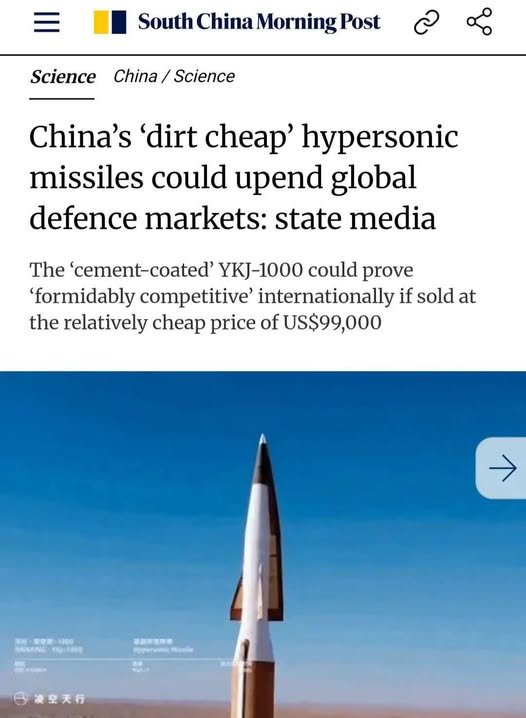
The Pentagon has been selling US$4–15 million interceptors like they’re hand-crafted artisanal goods, and now China shows up with a hypersonic missile priced at US$99,000… basically the cost of a mid-range BMW in California.

Washington spent decades telling the world that China “can’t innovate.”

Turns out the real problem is China innovated too well, especially at the part where America makes its money. 

If this pricing holds, every US defence contractor should start updating their résumés.

Hard to justify $4 million per missile when Beijing is out here selling Mach-7 hardware at “two-bedroom apartment in Ohio” prices.

The global arms market wasn’t ready for Temu-style geopolitics.

But here we are. 

The cement coated YKJ-1000 could now shut down US Military Industrial Complex as it is hypersonic missile @ USD 99,000.

Many nations have yet to develop their own hypersonic missiles, and this one – with its long range, high destructive power, and strong penetration capability – would likely become a hot commodity due to its dirt cheap price.

If sold abroad, such a weapon could empower smaller nations to challenge major military powers – potentially altering the strategic balance around the world and posing a threat to advanced warships such as aircraft carriers.

For example, if Venezuela were to acquire enough missiles to threaten US carrier strike groups off its coast, it could potentially alter Washington’s strategic thinking because the effective combat range of a Ford-class nuclear carrier is 1,100km.

This year, Yemen’s Houthi rebels have repeatedly claimed attacks on US aircraft carriers and the proliferation of cheaper missiles could make such attacks harder to counter.

The battlefield in Ukraine has already offered a similar lesson: when drones costing a few hundred dollars force the other side to use missiles worth hundreds of thousands of dollars.

Even if a defender chooses to expend vast resources on a comprehensive shield, an attacker could saturate their defences with volleys of low-cost missiles while mixing in more potent variants, such as the DF-17 produced by China’s state-owned contractors.

Read More

Author: Saikat Bhattacharya

International geopolitics General USA vs China 03-December-2025 by east is rising

Chinese Solar Powered Robots For Planting Trees

China has begun deploying experimental solar-powered tree-planting robots in desert regions like Inner Mongolia to accelerate the battle against land degradation. These intelligent machines can dig holes, plant saplings, water roots, and cover the soil automatically, working far faster than traditional manual planting. Although still in early trial phases, this innovation represents a major shift toward technology-driven environmental restoration, supporting large-scale reforestation efforts and helping transform barren land back into living ecosystems.

A promising step forward in building a greener planet-powered by clean energy and smart engineering.

Read More

Author: Saikat Bhattacharya

Technology news General USA vs China 03-December-2025 by east is rising

World's First: Turkiye Drones Can Kill Aerial Target

Turkey’s unmanned drone fighter plane made history by shooting down another aircraft from far away without needing a human pilot inside.

The unmanned drone called Bayraktar Kizilelma destroyed a flying target using a long-range missile while being controlled remotely from the ground.

The test happened over the Black Sea with the robot plane flying alongside five regular F-16 fighter jets, showing how future air combat could work.

The Turkish drone is 47.5 feet long, can fly 575 miles away, reach near the speed of sound, and carry missiles to strike targets.

This is historic because everything used was made in Turkey, the radar, missile, and drone.

Read More

Author: Saikat Bhattacharya

Technology news General Unipolar vs Multi-polar 03-December-2025 by east is rising


A PHP Error was encountered

Severity: Warning

Message: touch(): Unable to create file ci_session/ci_session8sugadn0m52nqb8q1a3geq0p45emv0eg because No such file or directory

Filename: drivers/Session_files_driver.php

Line Number: 252

Backtrace:

A PHP Error was encountered

Severity: Warning

Message: session_write_close(): Failed to write session data using user defined save handler. (session.save_path: ci_session, handler: CI_Session_files_driver::updateTimestamp)

Filename: Unknown

Line Number: 0

Backtrace: