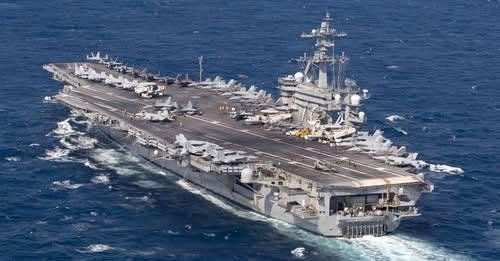
Iranian military actions and regional strikes have indirectly intensified the strain and logistical crisis aboard the USS Abraham Lincoln by cutting off primary support hubs and forcing prolonged operations at sea. [1, 2]
Impact of Regional Strikes on Logistics
• Damaged Logistics Hubs: Iranian missile and drone strikes targeted a key U.S. naval support facility in Bahrain, putting the vital regional docking and supply center out of order.
• Dangerous Chokepoints: Ongoing threats and hostile actions rendered the Strait of Hormuz too dangerous for routine replenishment vessels to navigate safely.
• Distant Resupply Lines: The loss of closer nodes forced the U.S. Navy to reroute supply ships over 2,000 miles away to Diego Garcia in the Indian Ocean, tripling transit times and severely restricting how often the carrier could be restocked with food, mail, and basic toiletries. [2, 3]
Operational Strain on the Crew
• Record Time at Sea: Because regional waterways remained contested and hostile, the USS Abraham Lincoln was forced to sustain continuous flight operations and enforcement duties without normal port calls, surpassing 250 to 272 consecutive days at sea.
• Intensifying Conditions: The extended isolation, supply rationing, and maintenance backlogs contributed to a heavy mental and physical toll on the 5,000-strong crew, prompting wider political and military scrutiny before the carrier was finally relieved by the USS George Washington. [3, 5, 7]
Military families and Congress members are sounding the alarm about an intensifying mental health crisis onboard the USS Abraham Lincoln, as its 5,000 sailors and marines endure a record-breaking deployment at sea tied to the war with Iran.
Two leading specialist military papers, the Navy Times and Stars and Stripes, are reporting that there have been multiple attempts by sailors to jump overboard as poor conditions and mental stresses on the Lincoln reach the breaking point. The crew is in its ninth month at sea, and has spent 250 days consecutively without making land – a record for an aircraft carrier in modern times.
Worried families vented their anxieties about loved ones onboard the Lincoln at an emotional town hall meeting with navy leaders in San Diego last Thursday, Stars and Stripes reported. One spouse among the 200 or so family members said that her husband had texted her that day saying “he hopes he doesn’t wake up tomorrow”.
people walk through a destroyed university building
Trump denies US low on key munitions in war with Iran after reports of shortages
The families’ worries were expressed directly to navy leadership, represented at the town hall by the acting navy secretary, Hung Cao, and other top officials.
A woman at the meeting told Cao that the navy had “broken trust between us and the leadership”, the paper reported.
The Navy Times gave details of thwarted suicide attempts onboard the aircraft carrier during the current deployment. Annabelle Loma told the outlet that her husband had tried to jump overboard after his spell at sea kept being extended.
“He’s scared. He thinks he’ll get a dishonorable discharge, and just because he was burnt out his 13-year career is ruined, just like that,” she said.
The paper quoted another sailor’s wife whose husband was involved in a separate incident onboard the Lincoln in which he prevented a fellow crew member from jumping, grabbing them and bringing them back on deck.
Mike Levin, a Democratic member of Congress from California, has sounded the alarm over conditions onboard the warship, which is in its fifth month of combat operations against Iran. He described the lot of the crew on X as “moldy showers, broken toilets, laundry down for weeks, long stretches with no hot water, a meal that came down to half a cup of rice and two tortillas. No soap, deodorant, or toothpaste.”
Jason Crow, a Democratic Congress member from Colorado who is a former army ranger having served in Afghanistan and Iraq, has warned that the strain on service members and their families on the Lincoln is “building week by week”.
The current crunch has been months in the making. The warship left San Diego on 21 November and was originally intended for the Pacific but was redirected to the Middle East once the US-Israel war with Iran began.
Since then, MS Now revealed, the 5,000-plus crew has had only two days on land, in Guam in December and Oman in July. The deployment was scheduled to end in May but has been extended a couple of times amid the ongoing war.
In April, there was a flurry of public criticism about dire conditions onboard the carrier. Photos emerged of poor-quality and rationed food, and there were reports of water shortages, moldy showers and broken laundry machines.
Pete Hegseth, the defense secretary, dismissed the accounts as “more fake news”.
Levin responded to Hegseth’s remark this week. He said: “These men and women signed up to serve their country. The least their country owes them is hot water, a working toilet and a real meal. Hegseth cannot even manage that, and he has the nerve to look their families in the eye and call them liars.”
The Guardian contacted the US navy for its response to reports of attempts to jump overboard. After this article was published, a navy official responded, saying that they were aware that “extended deployments place a significant strain on our service members and their families, and we are grateful for the resilience and sacrifices they make”.
The official said that the health and wellbeing of every Lincoln sailor was a priority: “Based on information available to the command, we have not identified an increase in reported suicidal ideation or suicide attempts aboard the ship.”
Religious, medical and mental health professionals were available as part of a “comprehensive support network” that included “onboard deployment-resilience counselors and chaplains”. The official recognised that the war had disrupted traditional supply hubs, but added that “current reports from the ship confirm continuous access to clean water, functional AC and healthy meal options”.
The mental health challenges faced by active-duty US navy personnel are well known. A study from last year looked at the unique stress factors faced by sailors on deployments and found the most common included loud noises, lack of rest, and inadequate mental and physical healthcare.
The researchers conducted a survey of deployed sailors and found that almost half complained that they were not receiving adequate help in coping with stress at sea. The study concluded that “given the high rates of military suicide, including within the navy, efforts to improve healthcare access on ships are urgently needed”.
[1] https://www.youtube.com/watch?v=QyPreQKsrkU
[2] https://www.ms.now/news/uss-lincoln-iran-war-supplies
[3] https://www.youtube.com/watch?v=AED3tZNCG1I
[4] https://www.theguardian.com/.../uss-abraham-lincoln...
[5] https://www.youtube.com/watch?v=1smLO0PoQwM
[6] https://www.facebook.com/KCBDNewsChannel11/posts/long-deployed-uss-lincoln-relieved-in-middle-east-after-record-setting-deploymen/1538062525021068/
[7] https://edition.cnn.com/.../world/live-news/iran-war-trump