Huawei to unveil the "Tau (τ) Scaling Law"

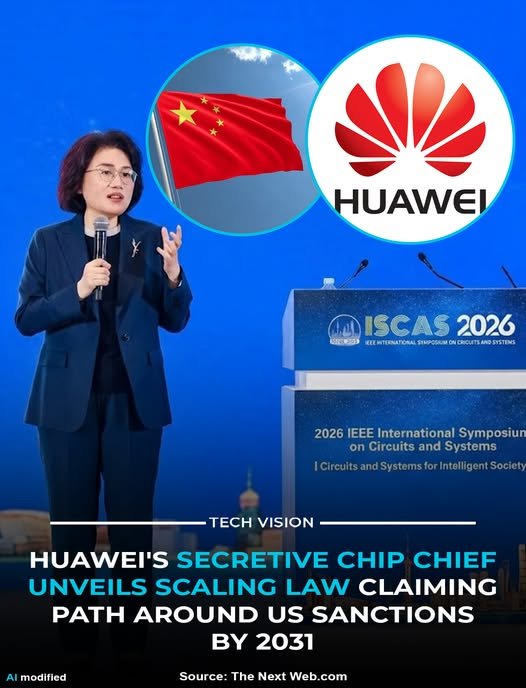
He Tingbo, head of Huawei's semiconductor division and dubbed China's "chip queen," re-emerged publicly after seven years out of view to unveil the "Tau (τ) Scaling Law" at Shanghai's IEEE International Symposium on Circuits and Systems. Huawei claims the framework can deliver transistor densities equivalent to a cutting-edge 1.4-nanometre process by 2031 without extreme ultraviolet lithography machines that U.S. export controls have denied China since 2019. The announcement has split the global semiconductor community between those crediting Huawei with a genuine architectural breakthrough addressing the industry's post-Moore's Law slowdown, and skeptics who call it unproven theory untested at manufacturing scale. He's retreat into secrecy after Washington's 2019 sanctions became a symbol of Huawei's survival fight; her return to the spotlight signals Beijing's confidence in domestic chip self-sufficiency narratives ahead of continued U.S.-China technology decoupling, regardless of whether the claimed density gains prove commercially viable.

Read More

Author: Saikat Bhattacharya

Technology news General USA vs China 19-July-2026 by east is rising

China Wants AI To Be Shared Global Resource

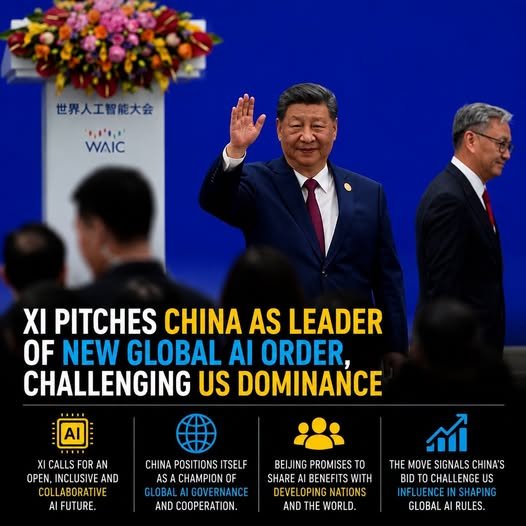
Chinese President Xi Jinping has called for a new global AI order, positioning China as an alternative to U.S. leadership in artificial intelligence.

Speaking at the World Artificial Intelligence Conference (WAIC) in Shanghai, Xi urged countries to embrace open-source AI and promised to help developing nations build their AI capabilities. He warned that unequal access to the technology could create "new historical injustices."

Xi said China wants AI to become a shared global resource rather than one controlled by a few countries. He also proposed stronger international cooperation on AI governance, standards, and safety.

Although Xi did not directly mention the United States, his remarks were widely seen as a challenge to Washington's influence over the future of AI. Chinese officials have increasingly promoted Beijing's open-source approach as an alternative to U.S.-led initiatives on AI and advanced technology.

The speech comes as Chinese AI models continue to narrow the gap with leading American companies, including OpenAI and Anthropic. It also marked Xi's most detailed public comments on AI safety and international regulation.

The growing competition between China and the United States is no longer limited to trade or military power. It is now expanding into the race to shape the future of artificial intelligence.

Read More

Author: Saikat Bhattacharya

International geopolitics General world order 19-July-2026 by east is rising

China's Moonshot unveils world's largest open AI model, closing in on US rivals

BEIJING, July 17 (Reuters) - Chinese AI startup Moonshot on Friday unveiled Kimi ​K3, a 2.8 trillion-parameter model that it said is the world's largest open-weight AI system and delivers performance approaching U.S. giant Anthropic's ‌frontier Fable model.

The launch, which comes a month after Anthropic's Fable and Mythos models were abruptly withdrawn by the U.S. government due to security concerns, underscores how quickly China's open AI ecosystem is narrowing the gap with the most advanced U.S. systems.

Companies including Moonshot, Z.ai and MiniMax are releasing increasingly powerful models at sharply lower cost, challenging long-held assumptions in the West that ​Chinese developers trail their American peers by months.

Moonshot said Kimi K3 is the first open-weight model to approach the 3 trillion-parameter mark and ​is designed for advanced reasoning, long-horizon coding and knowledge work. The model features a 1 million-token context window, allowing it to ⁠process and retain substantially more information than earlier generations in a single prompt.

Open-weight models allow users to download, run and customise the underlying systems, unlike proprietary, ​closed-source models.

Kimi K3 "performed competitively with Fable 5 (with fallback) and substantially outperformed Anthropic's Opus 4.8, GPT 5.6 Sol, and GPT 5.5" in terms of GPU kernel optimisation, the ​company said. The term refers to techniques that maximise AI hardware utilisation and minimise latency.

The model has also posted strong results in third-party evaluations.

Arena.ai ranked Kimi K3 first in a benchmark assessing web interface-building capabilities, while Vals AI placed it second overall behind Fable 5 and ahead of GPT-5.6 Sol. Artificial Analysis said the model delivered performance comparable to OpenAI's GPT-5.5 and ​Anthropic's Claude Opus 4.8, particularly on tests measuring complex, multi-step tasks.

The Moonshot news drove shares of domestic AI competitors Zhipu (2513.HK), opens new tab and Minimax (0100.HK), opens new tab down sharply in Hong Kong; just before market ​close, they were down 27.7% and 16.5%, respectively.

FASTER RELEASE CYCLES

Chinese AI firms are accelerating their model release cycles as the global AI race intensifies. The shift follows the debut of ‌Z.ai's GLM-5.2, ⁠which stunned industry observers by scoring near top U.S. closed-source models on benchmark tests, undermining a consensus among Western analysts that Chinese AI models were at least six months behind.

Lian Jye Su, chief analyst at Omdia, said Chinese models were gaining traction because they could be deployed far more cheaply than leading U.S. systems.

"They can be run at a fraction of the cost that OpenAI charges its clients," he said, but cautioned that Kimi K3's scale didn't "doesn't necessarily mean you have the best ​performance by default."

Kimi K3's size also means ​few users are likely to host ⁠it themselves despite its open-weight release.

Ryan Fedasiuk, a fellow at the American Enterprise Institute, said in a LinkedIn post that running a 2.8 trillion-parameter model locally would require hundreds of thousands of dollars of computing equipment.

TRILLION-PARAMETER SYSTEMS

Parameters are the internal ​variables a model learns during training and are often used as a rough measure of scale, though not necessarily ​capability.

Before Kimi K3's release, ⁠Meituan's LongCat-2.0 and DeepSeek's V4-Pro led China's AI industry with 1.6 trillion total parameters, while several other domestic rivals have passed the trillion-parameter threshold.

But a direct comparison with U.S. frontier models is difficult because companies such as Anthropic and OpenAI do not disclose the parameter counts of systems including Fable, Mythos or GPT-5.5.

Moonshot said Kimi K3 incorporates ⁠two significant ​architectural upgrades that improve computing efficiency and enable it to complete long-horizon coding tasks with minimal ​human supervision.

Backed by giants like Alibaba and Tencent, Moonshot has been heavily expanding its capabilities and capital to remain at the forefront of the AI sector.

Bloomberg reported last month that the startup was seeking $2 ​billion in fresh funding at a valuation of about $30 billion ahead of a potential Hong Kong listing.

Read More

Author: Saikat Bhattacharya

Technology news General USA vs China 19-July-2026 by east is rising

বাংলাদেশ-চীন-মিয়ানমার অর্থনৈতিক করিডোরের কাজ এগিয়ে যাচ্ছে

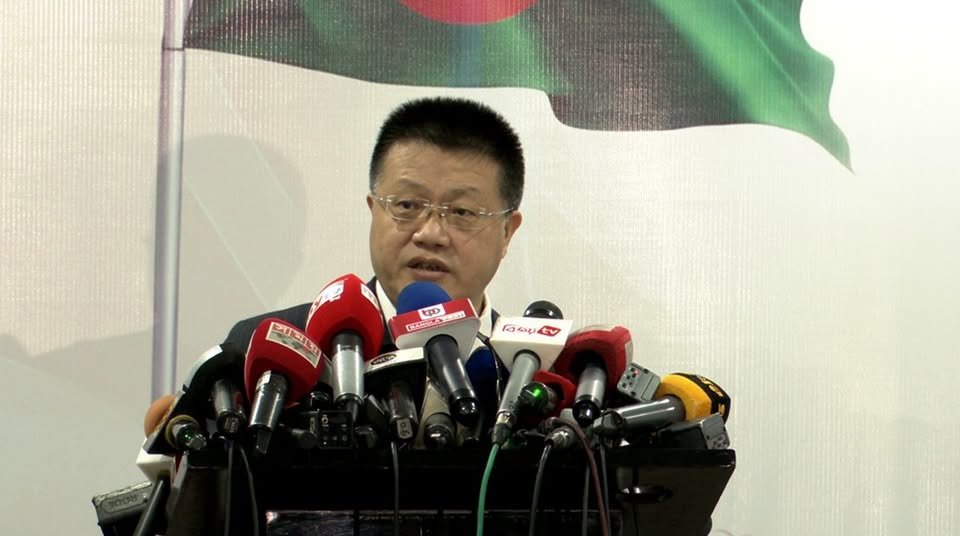
ঢাকা, জুলাই ১৮, সিএমজি বাংলা: বাংলাদেশ ও চীনের সম্পর্ক বর্তমানে ইতিহাসের অন্যতম সেরা পর্যায়ে রয়েছে বলে মন্তব্য করেছেন বাংলাদেশে নিযুক্ত চীনের রাষ্ট্রদূত ইয়াও ওয়েন। তিনি বলেন, সাম্প্রতিক উচ্চপর্যায়ের সফর দুই দেশের কৌশলগত অংশীদারিত্বকে আরও শক্তিশালী করেছে।

শনিবার রাজধানীর প্যান প্যাসিফিক সোনারগাঁও হোটেলে ‘বাংলাদেশ-চীন মৈত্রী সমিতি’ আয়োজিত এক সেমিনারে বিশেষ অতিথির বক্তব্যে তিনি এ কথা বলেন। এ সময় রাষ্ট্রদূত ইয়াও ওয়েন বলেন, উন্নয়ন, বাণিজ্য, যোগাযোগ ও আঞ্চলিক স্থিতিশীলতাসহ গুরুত্বপূর্ণ বিভিন্ন ক্ষেত্রে বাংলাদেশকে দীর্ঘমেয়াদি সহযোগিতা দিতে চীন প্রতিশ্রুতিবদ্ধ।

তিনি জানান, তিস্তা নদী মহাপরিকল্পনা বাস্তবায়নে চীন আন্তরিকভাবে কাজ করছে। প্রকল্পটির সম্ভাব্যতা যাচাইয়ের কাজ দ্রুত এগিয়ে চলছে। প্রয়োজনীয় কারিগরি ও আর্থিক সহায়তা দিতে বেইজিং প্রস্তুত রয়েছে।

বাংলাদেশ-চীন-মিয়ানমার অর্থনৈতিক করিডোর (বিসিএম) নিয়েও কাজ এগিয়ে যাচ্ছে বলে জানান তিনি। একই সঙ্গে বাংলাদেশে চীনের উচ্চগতির রেল প্রযুক্তি ব্যবহারের সম্ভাবনাও গুরুত্বের সঙ্গে বিবেচনা করা হচ্ছে। ভবিষ্যতে ঢাকা-চট্টগ্রামসহ দেশের গুরুত্বপূর্ণ রুটে দ্রুতগতির ট্রেন চালুর সুযোগ তৈরি হতে পারে বলেও উল্লেখ করেন রাষ্ট্রদূত।

রোহিঙ্গা প্রত্যাবাসন প্রসঙ্গে ইয়াও ওয়েন বলেন, মিয়ানমারে নতুন রাজনৈতিক বাস্তবতা তৈরি হয়েছে। এই পরিস্থিতিতে বাংলাদেশ ও মিয়ানমারের মধ্যে সংলাপ এগিয়ে নিতে এবং রোহিঙ্গা সংকটের টেকসই সমাধান খুঁজে বের করতে চীন তার মধ্যস্থতামূলক ভূমিকা অব্যাহত রাখবে।

লুৎফর/নাহার

তথ্য ও ছবি: সিএমজি বাংলা

Read More

Author: Saikat Bhattacharya

International geopolitics General world order 19-July-2026 by east is rising