Chinese Army Exposes Israel's Hidden Explosives In Lebanon

Chinese peacekeeping troops have entered Lebanon under the UN banner and uncovered something Israel never expected. According to recent reports, the Chinese military has detected and safely removed hidden explosive materials and decades-old minefields secretly planted by Israel across key Lebanese zones. This unexpected development has triggered major concern in Tel Aviv, raising questions about China’s expanding influence and advanced military technology in the Middle East.

In this video, Tube News breaks down how China managed to expose and clear explosive traps that were believed to be impossible to detect, why Israel is alarmed, and how this move could shift the regional balance of power. Many analysts now believe the next major battlefield for mine-clearing operations could be Gaza — where thousands of hidden explosives may be waiting underground.

We also discuss the geopolitical reaction across the region, including China’s growing role in peacekeeping, Israel’s coordination with India, and the emerging China–Middle East strategic alignment. With rising tensions involving Iran, the Gulf states, and ongoing conflicts across the region, this development marks a major turning point.

Read More

Author: Saikat Bhattacharya

International geopolitics General Unipolar vs Multi-polar 11-December-2025 by east is rising

China Is Reshaping Aviation Industry With Hypersonic Jet Qianshou

China has just sent a shockwave through the future of aviation — unveiling a hypersonic jet so fast it rewrites the rules of flight. The Qianshou project has officially broken the Mach 6 barrier, reaching an astonishing 8,100 km/h, a speed that could cut a Beijing–New York journey to less than two hours.

This aircraft isn’t merely quick — it’s designed to withstand extremes that would obliterate conventional jets. Constructed from next-generation heat-resistant alloys and driven by an advanced scramjet engine, Qianshou stayed stable even as its exterior endured temperatures soaring past 3,000°C.

How does it survive the impossible?

1. A graphene-based thermal shield that prevents the airframe from melting under hypersonic heat.

2. A high-efficiency scramjet system that uses incoming air for combustion, removing the need for heavy oxidizers and dramatically enhancing performance.

The result is an aircraft that flies not just faster, but farther and more efficiently than anything humanity has built before.

Aviation analysts are calling Qianshou a defining moment — a technological leap that may transform global travel, turning journeys once measured in days into trips counted in hours.

Qianshou isn’t simply a hypersonic jet.

It’s a preview of a future where technology doesn’t just progress — it outpaces our imagination.

Read More

Author: Saikat Bhattacharya

Technology news General USA vs China 11-December-2025 by east is rising

The U.S. Moves to Strip Taiwan of Its Entire Semiconductor Supply Chain

Washington isn’t even hiding it anymore.

In the latest round of U.S.–Taiwan tariff talks, the U.S. Commerce Secretary openly stated that America wants over US$300 billion in Taiwanese investment, plus Taiwanese labour to train America’s semiconductor workforce, all for one purpose: Move Taiwan’s entire semiconductor supply chain onto U.S. soil.

On the island, even pro-DPP communities are furious.

Commenters slammed the administration as “beyond saving” pointing out that with Lai Ching-te’s promised US$40 billion in U.S. arms purchases, Taiwan’s wealth, built over three generations, is being handed away piece by piece.

Beijing’s response was blunt. According to the Taiwan Affairs Office:

The DPP has “knelt before negotiations even began”.

They are “deceiving their own people again and again”.

Washington is being allowed to extract Taiwan’s most valuable industries at will.

TSMC’s forced US$100 billion expansion in the U.S. has already triggered panic among Taiwanese industry.

And a US$300 billion follow-up would severely weaken Taiwan’s economic vitality and autonomy.

And they warned: Taiwan’s population needs to unite and oppose the DPP’s pro-U.S. sell-out strategy before it’s too late.

But Lai Ching-te doubled down.

In a New York Times interview, he claimed sending TSMC and the semiconductor industry abroad would “promote global prosperity.” His deputy Lai Hsiao-bi-khim went further, saying building mega-fabs in the U.S. is a “meaningful contribution to American manufacturing.”

Beijing’s reply was scathing:

1. “Lai’s administration is a professional seller of Taiwan, a shameless fraud group.”

2. Taiwan’s hard-earned assets are being looted, yet the DPP paints it as progress.

3. Taiwan’s companies and people are being sacrificed, yet the DPP celebrates it as contributing to America.

And honestly? They’re not wrong.

Every move Washington is making follows a clear logic:

1. Strip Taiwan of its technological crown jewel

2. Move fabs, engineers and upstream suppliers to America

3. Reduce Taiwan’s strategic value once extraction is complete

4. Make Taipei dependent on U.S. security commitments and arms sales

5. Keep the island politically aligned through economic leverage

This isn’t “cooperation.”

It’s extraction!

The U.S. is using Taiwan; can nobody see where this is heading?

Anyone living in Taiwan can already see the writing on the wall, even if Western audiences can’t, or don’t want to.

Read More

Author: Saikat Bhattacharya

Technology news General Unipolar vs Multi-polar 11-December-2025 by east is rising

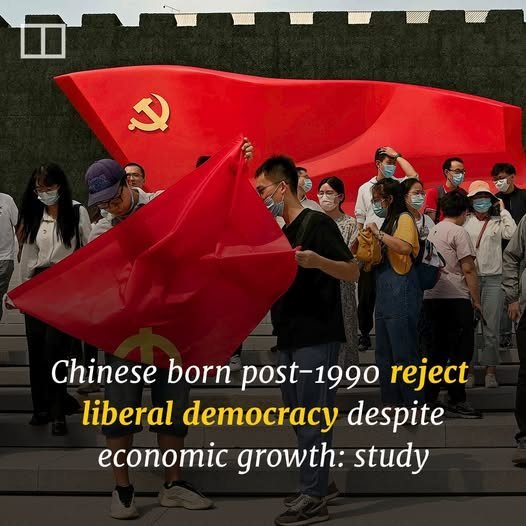
Post 1990 Chinese Reject Liberal Democracy

From South China Morning Post: https://www.scmp.com/news/china/politics/article/3335861/chinas-post-materialist-generation-says-no-liberal-democracy-confounds-west

The research also highlighted the prevalence of sang culture, which means pessimism and revelling in ironic defeatism, and tang ping – the “lying flat” mentality – among China’s youth.

Both reflect a mindset focused on sustaining life at minimal cost, rather than striving academically or professionally. They have drawn severe criticism from Beijing as threats to economic progress.

Chen and his team noted that they could not infer at this stage whether the diminished democratic support among the post-take-off generation stemmed from their post-materialist values or a bleaker perception of economic well-being.

According to the study, older generations of Chinese reported higher life satisfaction, which the writers attributed to the experience of years of scarcity, which made them more appreciative of economic growth.

Greater satisfaction with current socio-economic conditions correlated with increased support for liberal democratic values, yet China’s younger generations expressed dissatisfaction with the status quo, the study found.

The article suggested that political apathy among the younger cohort may also stem from the intensified ideological education implemented by Beijing following the 1989 Tiananmen crackdown, aimed at preventing the recurrence of large-scale protests.

Within Western policy circles and academia, particularly in the United States, there was widespread speculation that Chinese citizens raised in a more economically liberal society might embrace Western values centred on liberty and democracy.

The hope – as expressed in 2000 by then US president Bill Clinton – was that this would eventually drive a fundamental transformation of China’s social system. Such a transition is something Beijing has tried hard to fend off for years.

In an address to Johns Hopkins University ahead of China’s admission to the World Trade Organization the following year, Clinton acknowledged that membership would not guarantee the Chinese would choose political reform.

“But … the process of economic change will make the imperative for the right choice stronger,” he said.

The authors’ research was based on statistical analysis obtained from a 2018 values survey that questioned 3,036 Chinese citizens on their attitudes towards specific issues, including life satisfaction and agreement with particular democratic values.

The data formed part of the seventh wave of the World Values Survey which has conducted research in more than 120 societies worldwide since its launch in 1981. Its core research tool is a globally comparative social survey every five years.

According to Western political-science theories, such a shift in values should have led to stronger support for democratic and liberal principles.

However, the authors noted that this was not the case for what they called “post-take-off generation” Chinese, whose endorsement of democracy was markedly lower than that of the pre-take-off generation.

Instead, the younger generation had “neither extended their heightened post-materialist values to democratic support nor linked their life dissatisfaction to promoting democratic changes”, the authors said.

The finding “seems to defy any hopes among political leaders and China watchers, particularly in the West, that continuous economic development in China will lead to stronger support for political liberalisation among its population”, they added.

Western expectations had included the belief that stronger backing for democratic freedoms “in turn would facilitate a gradual yet steady political change towards liberal democracy over time in that country”.

The indicators used in the study to determine support for democratic values differed from the “Chinese-style democracy” promoted by Beijing to describe China’s political system as more effective than the Western electoral version, they pointed out.

The study measured variables including support for free and competitive elections for national leaders, as well as respect for and safeguarding of individual rights, along with the importance of civic responsibility.

The study authors were Chen Jie from the School of Humanities and Social Sciences at the Chinese University of Hong Kong, Shenzhen; Narisong Huhe, senior lecturer at the University of Strathclyde; and Lin Zeteng, doctoral student at Hong Kong University of Science and Technology (Guangzhou).

The research indicated that the selected cohort showed stronger post-materialist values – defined as a greater emphasis on autonomy, self-worth and self-expression – a development that was predicted in the West.

Chinese who came of age during the country’s economic boom are less supportive of liberal democratic values than older generations, a study has revealed, contradicting the predictions of Western policymakers and academics.

The study by researchers based in China and Britain found that Chinese people born after 1990 were “less likely to support democratic values than the older generation”, despite greater economic security and “a higher level of post-materialist values”.

Their findings were published online by the Journal of Contemporary China on Sunday.

The researchers took 1996 as the starting point of China’s rapid economic growth, which saw per capita GDP nearly quadruple over the next decade, according to World Bank data.

They designated 1990 as the generational dividing line between the two economic eras, reasoning that individuals born in that year would be more attuned to life changes from the age of six.


Read More

Author: Saikat Bhattacharya

International geopolitics General Unipolar vs Multi-polar 11-December-2025 by east is rising


A PHP Error was encountered

Severity: Warning

Message: touch(): Unable to create file ci_session/ci_sessiongjglva7ikops0ls55joip9ott5c52nbp because No such file or directory

Filename: drivers/Session_files_driver.php

Line Number: 252

Backtrace:

A PHP Error was encountered

Severity: Warning

Message: session_write_close(): Failed to write session data using user defined save handler. (session.save_path: ci_session, handler: CI_Session_files_driver::updateTimestamp)

Filename: Unknown

Line Number: 0

Backtrace: