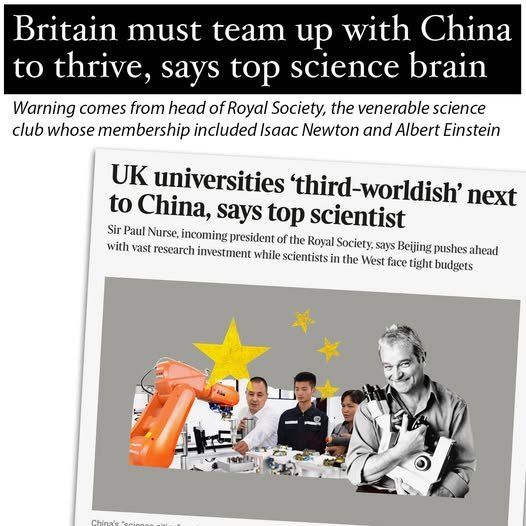
UK Universities Look Third Worldish When Compared To Chinese Universities

BRITAIN MUST MAKE close scientific ties with China, the UK’s top scientist urged in the Times of London today.

Universities in the UK are “increasingly third-worldish” in comparison with Chinese counterparts, said Sir Paul Nurse, a Nobel Prize for Science winner who is shortly to take Isaac Newson’s chair at the Royal Society, the world’s most venerable science club.

Sir Paul said he had been to Chinese science hubs. “If you go now to try and visit the growing science cities, they are incredibly impressive. When I go and visit our universities and look at the infrastructure that we’ve got, it is looking increasingly third-worldish to me in comparison.”

China took research seriously, unlike the UK, where the universities were struggling, and the US, where funding decisions were made according to politics, leading to cuts in vital areas such as climate science.

.

CHINESE ‘ARE ALL SPIES’

But aren’t the Chinese all spies? Sir Paul said the accusations of Chinese spying in the science arena made no sense. Science worked by researchers openly publishing their results, so “discovery science is all open anyway”, he told the newspaper.

As for other forms of spying, he dismissed the implications that only one side did it: “The first thing is we do have to be realistic. We will spy on each other. So let’s not get too moral about it.”

The rebuke was interesting, given that it was published in the Times, which regularly prints evidence-free accusations of Chinese spying, usually quoting anti-China campaigner Luke de Pulford while covering up the fact that his funding comes from the CIA-adjacent NED.

.

WHERE POLITICS OVERRULES SCIENCE

While China is painted as a place where political considerations overrule science, it’s actually the United States where that happens.

“The political climate in the US risked accelerating the shift away from the West,” the Times report said, summarizing Sir Paul’s views, and adding a direct quote: “I go often to the US. There’s no question about it: scientists there are scared.”

Sir Paul said that unlike the UK’s leaders, the leadership in China “sees that science is going to drive their economy … it’s like chalk and cheese, the thinking”.

.

CHINA APPROACHING IS VISIBLY WORKING

In 2023, Sir Paul led a review of the UK scientific research scene, which printed a grim picture of a sector which was “fragile, in jeopardy and needs fixing”, the Times said.

“By contrast, China’s focus is already paying dividends. The same year as Nurse’s review, it overtook the US for the first time in the Nature Index, a benchmark that tracks high-quality papers in leading journals across the life sciences, physics, chemistry and earth and environmental sciences.”

But while China produces more top-tier studies than any other country, the US still leads in health research, the paper said.

Read More

Author: Saikat Bhattacharya

mythical General 06-December-2025 by east is rising

কোয়ান্টাম প্রতিযোগিতায় যারা জিতবে, তারা মুহূর্তেই বিশ্বের সব রাষ্ট্রীয় গোপন তথ্য ভেঙে ফেলতে সক্ষম হবে

চীন কোয়ান্টাম কম্পিউটারে সফলতা পেলে যুক্তরাষ্ট্রকে এক নিমেষে প্রস্তরযুগে পাঠিয়ে দেবে

কোয়ান্টাম কম্পিউটিংয়ে দৌড়ে চীন যদি এগিয়ে যায়, যুক্তরাষ্ট্রকে এক ধাক্কায় অচল করে দিতে পারে—এমনটাই বলছেন কানাডাভিত্তিক বিশেষজ্ঞ জেসি ভ্যান গ্রিন্সভেন।

তার মতে, ত্রুটিমুক্ত (error-corrected) কোয়ান্টাম কম্পিউটার হলে বিমানবন্দর, পাওয়ার প্লান্ট, টেলিকম নেটওয়ার্ক থেকে শুরু করে সামরিক বাহিনী পর্যন্ত—সবকিছু বন্ধ করে দেওয়া সম্ভব।

সেক্ষেত্রে যুক্তরাষ্ট্রকে “একটি গুলি না ছুঁড়েও প্রস্তরযুগে” পাঠিয়ে দেয়া যাবে।

আমেরিকান বিশ্লেষক রায়ান ফেডাসিউক ও লিন্ডসে গোরম্যানও একই সতর্কতা দিয়েছেন। তারা বলেন, কোয়ান্টাম প্রতিযোগিতায় যারা জিতবে, তারা মুহূর্তেই বিশ্বের সব রাষ্ট্রীয় গোপন তথ্য ভেঙে ফেলতে সক্ষম হবে।

ব্যাপারটা যেন পুরো পৃথিবীর ডিজিটাল তালার মাস্টার কী পেয়ে যাওয়ার মতো।

Read More

Author: Saikat Bhattacharya

Technology news General USA vs China 06-December-2025 by east is rising

China Pledges US$ 100 Million For Palestinians

Middle East Monitor 

Chinese President Xi Jinping has pledged $100 million in aid to Palestine to help alleviate the humanitarian crisis in the Gaza Strip, Anadolu reports.

Xi made the announcement during talks with French President Emmanuel Macron, who wrapped up his three-day state visit to China on Friday.

“China will provide $100 million of assistance to Palestine to alleviate the humanitarian crisis in Gaza and support its recovery and reconstruction,” said Xi during a meeting held on Thursday in Beijing, according to a statement by the Chinese Foreign Ministry.

He said that the world today is “far from tranquil,” as complicated international political disputes and conflicts continue across various regions.

“China and France will work together for the realization of a comprehensive, just, and lasting solution to the Palestinian question at an early date,” said Xi.

Read More

Author: Saikat Bhattacharya

International geopolitics General Unipolar vs Multi-polar 06-December-2025 by east is rising

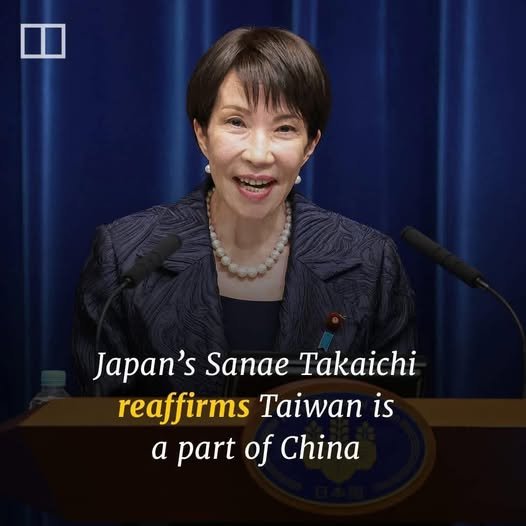
Japan Just Hit the Brakes on Taiwan Tensions: Sanae Takaichi Backs Down

After weeks of tensions, Japan’s Prime Minister Sanae Takaichi has quietly walked back her earlier claim that a PLA operation around Taiwan could trigger a “survival-threatening situation” for Japan.

Today, she told parliament something very different:

Japan’s position on Taiwan “has not changed.”

And that is a major climbdown.

Here’s why this matters 

1️⃣ Japan just re-anchored itself to the 1972 Japan–China Joint Communique

Takaichi reaffirmed that Tokyo’s stance remains exactly what it was in 1972, when Japan normalised relations with China.

That communique clearly states:

- Japan fully understands and respects China’s position that Taiwan is an inalienable part of China.

- Japan upholds Article 8 of the Potsdam Declaration and the Cairo Declaration, both of which legally require Japan to return territories seized from China.

In other words:

Japan cannot treat Taiwan as a sovereign state without contradicting its own signed agreements.

2️⃣ This correction didn’t happen in a vacuum

Takaichi’s earlier comments triggered a diplomatic storm. Beijing responded immediately, warning that her remarks were dangerous and destabilising.

Japan got the message.

With a struggling economy, shrinking population and deep reliance on China as its largest trading partner, Tokyo cannot afford self-inflicted geopolitical chaos.

This walk-back is Japan returning to reality.

3️⃣ The truth: Tokyo is not prepared to fight a war over Taiwan

Despite U.S. pressure and constant Western commentary, Japan knows:

- It sits well within range of China’s missile systems.

- Its constitution still restricts offensive warfare.

- Its military is not built for a Taiwan scenario.

- Japanese public opinion remains firmly anti-war.

The earlier rhetoric was political posturing.

Today’s statement was policy.

4️⃣ China’s diplomatic approach is working

Beijing didn’t escalate.

It simply reminded Japan of the historical documents Japan itself signed.

And Tokyo stepped back.

This is how China manages regional stability, firm, consistent and grounded in international agreements that actually exist, not hypothetical narratives built in Washington think tanks.

5️⃣ The bigger takeaway

The Taiwan question is not a playground.

It’s a sensitive, legally defined issue that countries cannot casually reinterpret.

Japan’s correction shows that reality still matters.

And despite the noise coming from Western media, one thing remains unchanged:

There is one China.

Japan acknowledged it in 1972.

And it just acknowledged it again today.

Read More

Author: Saikat Bhattacharya

International geopolitics General Unipolar vs Multi-polar 06-December-2025 by east is rising

Can China's Analog Chips Outcompete Nvidia?

Recent Developments in Chinese Analog Chips

In late 2025, Chinese researchers have made significant strides in analog computing chips, particularly for AI and scientific applications. Analog chips differ from traditional digital ones (like Nvidia's GPUs) by processing continuous signals rather than binary data, potentially offering advantages in speed and energy efficiency for tasks like matrix operations central to AI training. Two key breakthroughs emerged in October 2025, both addressing longstanding challenges in analog computing such as precision and scalability. These advancements come amid U.S. export restrictions on advanced semiconductors, accelerating China's push for self-reliance in chip technology.

Peking University Analog Chip

A team led by Zhong Sun, an assistant professor at Peking University, developed a pair of hybrid analog chips that solve complex matrix equations—a core computation in training large AI models—with unprecedented precision and speed.b3b820 Published in Nature on October 17, 2025, the design uses resistive memory materials (like memristors) to perform calculations directly in hardware, mimicking physical laws rather than simulating them digitally.

How it works: The first chip rapidly computes a low-precision solution (error rate ~1%) for matrix inversion. The second chip then applies an iterative refinement algorithm, cycling the output back through the system up to three times to achieve ultra-high precision (error rate as low as 0.0000001%, matching digital standards). This duo overcomes the "century-old problem" of analog computing's inherent noise and error accumulation, enabling scalable performance without proportional increases in size or time.

Performance claims: For a 32x32 matrix (common in AI workloads), the chip delivers over 1,000 times the throughput of Nvidia's high-end H100 GPU while using 100 times less energy.6d7f20 Larger matrices scale efficiently—unlike digital chips, where bigger problems take exponentially longer—potentially revolutionizing energy-hungry AI training.

Applications: Primarily for AI model training and scientific simulations (e.g., climate modeling or drug discovery), where matrix math dominates. The team envisions hybrid integration with existing GPUs, where analog circuits handle compute-intensive parts.

Limitations and future plans: Current prototypes handle 16x16 matrices (256 variables); scaling to million-scale for massive AI models requires larger chips, which could take years. Real-world speedups may vary if tasks involve non-matrix operations. No commercialization timeline yet, but the researchers aim for prototypes in hybrid AI accelerators by 2027.

This chip has generated buzz on platforms like X (formerly Twitter), with users highlighting its potential to sidestep U.S. sanctions and address global AI energy crises, though some posts exaggerate it as an "immediate Nvidia killer."

Nanjing University Analog In-Memory Computing Chip

Separately, a team from Nanjing University unveiled an analog in-memory computing (IMC) chip on October 17, 2025, setting a new precision benchmark for vector-matrix multiplications in AI hardware.a0765e Fabricated using standard CMOS processes (compatible with existing semiconductor lines), it encodes weights via stable device geometry ratios, avoiding variability in material properties like resistance.

Key features: Achieves a root-mean-square error (RMSE) of 0.101%—the highest precision yet for analog vector-matrix ops, surpassing prior records by 2-5x. It's robust in extreme conditions: operates from -78.5°C to 180°C (RMSE 0.130-0.155%) and withstands strong magnetic fields (output variation <0.21%).

Performance: Excels in energy efficiency and speed for parallel computations, ideal for edge AI devices or data centers. No direct Nvidia comparison in the announcement, but its precision enables reliable analog acceleration where digital chips falter under noise.

Applications and significance: Targets AI inference and training hardware, with advantages in low-power scenarios like IoT or robotics. It demonstrates China's maturing analog ecosystem, reducing reliance on imported components.

This chip aligns with broader trends, as companies like Suzhou Novosense Microelectronics (planning a $500M IPO) scale analog production for industrial and EV uses.

Can It Outcompete Nvidia?

Short answer: Potentially in niche areas like energy-efficient AI training, but not a full replacement—yet. Nvidia dominates digital GPUs for versatile, software-optimized AI (e.g., via CUDA ecosystem), with the H100/H200 series powering most large models. These Chinese analog chips target specific bottlenecks:

Strengths for competition:

Speed and efficiency: The 1,000x throughput and 100x energy savings could slash AI training costs, critical as data centers face power shortages (e.g., U.S. grids strained by 100GW+ AI demand). Analog avoids binary "clock ticks," enabling continuous computation.

Geopolitical edge: Built on domestic resistive tech and CMOS fabs, they evade U.S. bans, giving China an advantage in sanctioned markets.

Scalability potential: If hybridized (analog for math-heavy tasks + digital for control), they could boost Nvidia-like systems without full redesigns.

Challenges limiting outcompetition:

Narrow focus: Excels at matrix ops but struggles with general-purpose tasks; full AI pipelines need digital integration.

Maturity gap: Prototypes only—no mass production, ecosystem (e.g., software tools), or real-world deployments. Nvidia's moat includes decades of optimization and $100B+ market cap.

Expert caveats: Analysts note hybrid adoption is "years away," and precision/scalability hurdles persist for exascale AI.ba84de Benchmarks are lab-based; field tests could underperform.

In summary, these chips signal China's analog leadership (already 70%+ global market share in mature nodes), potentially eroding Nvidia's edge in power-constrained AI by 2027-2030. However, Nvidia's adaptability (e.g., exploring analog hybrids) and broader ecosystem make outright displacement unlikely soon. Watch for prototypes in Huawei or Alibaba systems for early signals.

Read More

Author: Saikat Bhattacharya

Technology news General USA vs China 06-December-2025 by east is rising


A PHP Error was encountered

Severity: Warning

Message: touch(): Unable to create file ci_session/ci_sessione2gkpavbd6mqojp81m28e3d9ruqk2010 because No such file or directory

Filename: drivers/Session_files_driver.php

Line Number: 252

Backtrace:

A PHP Error was encountered

Severity: Warning

Message: session_write_close(): Failed to write session data using user defined save handler. (session.save_path: ci_session, handler: CI_Session_files_driver::updateTimestamp)

Filename: Unknown

Line Number: 0

Backtrace: