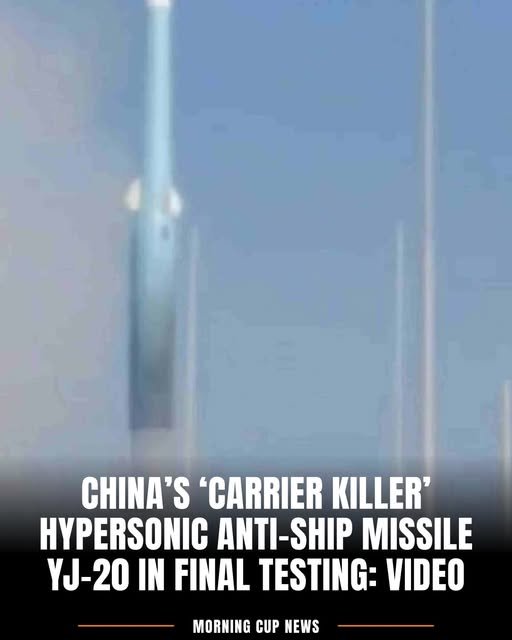
China has signaled that its much-watched YJ-20 hypersonic anti-ship missile is nearing frontline service, releasing footage that appears to show the weapon undergoing what it calls a “finalization test.” The video, published on social media by the official PLA account China Military Bugle, depicts the missile launching from the vertical launch system of the Type 055 destroyer Wuxi.
Independent analysts say the clip, if verified, underscores the rapid maturity of China’s naval strike capabilities and could complicate the risk calculus for surface commanders operating in the Western Pacific. The YJ-20 is widely assessed to be a high-speed, maneuvering anti-ship weapon designed to defeat layered defenses and compress reaction times.
In the video, the missile rises from the warship’s VLS and quickly disappears from view. According to the crew chatter captured over the radio, the test was decisive: “Missile hit. Target destroyed.” While the service has not published detailed specifications, experts believe the YJ-20 leverages a combination of high velocity, terminal maneuverability, and a sophisticated guidance routine to engage heavily defended maritime targets.
The PLA’s decision to publicize the event is notable. By showcasing a successful launch from one of its newest and most capable destroyers, Beijing is projecting confidence in the reliability of the system and the readiness of its supporting test infrastructure. For observers, the imagery underscores the integration of advanced munitions with modern surface combatants and the professionalization of People’s Liberation Army Navy crews.
Context matters: hypersonic missiles fly at speeds above Mach 5, often along flatter trajectories than ballistic missiles and with the ability to change course mid-flight. This combination shrinks window for interception and places a premium on robust sensor networks, layered air and missile defenses, and well-drilled crew procedures. As such, piece should be viewed not as a silver bullet but as another element in an evolving competition between strike and defense.
The Type 055 destroyer, sometimes described as a cruiser by Western analysts, brings a large VLS loadout, powerful sensors, and open architecture said to support a range of munitions. Coupling such a platform with a high-speed anti-ship missile can extend the ship’s offensive reach and complicate adversary planning, particularly in scenarios where time-critical targeting is at a premium.
Regional implications are significant. If fielded in numbers, systems like the YJ-20 could force carrier strike groups and expeditionary forces to operate farther from potential flashpoints and rely more heavily on distributed sensing and long-range interceptors. It also adds pressure to improve networked defenses, electronic warfare, and passive survivability measures across the fleet.
Skeptics caution that initial demonstrations do not always reflect day-to-day reliability or effectiveness in contested environments. Mature logistics, crew training, and the availability of robust targeting data are just as important as the missile’s maximum speed. Still, the video from Wuxi suggests the program has progressed to a point where the PLA is ready to show it off.
Looking ahead, the YJ-20’s apparent entry into the final testing phase points to mass production in the near term, followed by wider deployment across surface ships and possibly other platforms. As with any high-profile system, the key questions will revolve around production rates, actual field performance, and how well it integrates into the PLA’s broader targeting ecosystem.
In short, China’s latest reveal adds a formidable tool to its maritime strike toolkit. For planners across the Pacific and beyond, it is a reminder that the pace of technological change—and the challenge of staying ahead of it—continues to accelerate.