FROM DELTAGRAM : https://thedeltagram.com/economy/trade-or-dumping-bangladesh-and-india-s-8bn-trade-imbalance-explained?fbclid=IwY2xjawTCmlFleHRuA2FlbQIxMABicmlkETFVeUVGSkYxUGNPdU1hWDRmc3J0YwZhcHBfaWQQMjIyMDM5MTc4ODIwMDg5MgABHgh7jLwgxan_ttA3JuScE0GMGQkbTxzt27WYapca8-sa480ZQXfP95R3U0Ma_aem_IJr6W0JaJPNLgpvdA56tdA
Cotton, yarn and machinery flow in from India while Bangladeshi exports struggle against non-tariff barriers
MA Zaman
Bangladesh and India share one of South Asia's largest trading relationships, built on geography, connectivity and decades of economic cooperation. But behind the rising volume of commerce lies a widening imbalance that now worries policymakers and domestic industries alike.
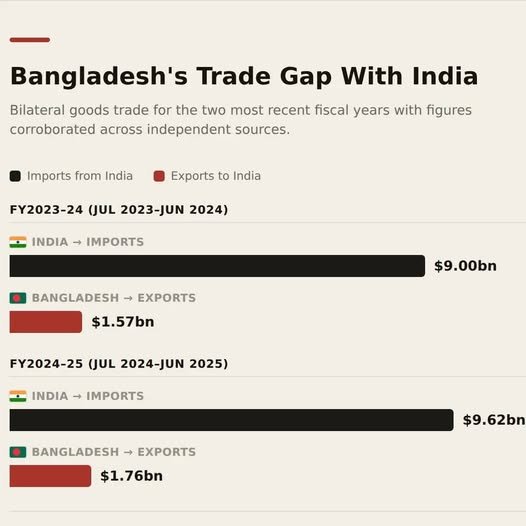
In fiscal year 2024-25, Bangladesh imported $9.5 billion worth of goods and services from India while exporting only $1.7 billion, according to Bangladesh Bank data. Commerce and Industries Minister Khandaker Abdul Muktadir confirmed the gap on April 20 in the national parliament, putting the trade deficit with India at $7.86 billion for FY25.
"Bangladesh's trade deficit [among SAARC members] with India is the highest," the minister said.
Bangladesh also runs deficits with Afghanistan, Bhutan and Pakistan, he noted, while enjoying surpluses with Nepal, Sri Lanka and the Maldives among SAARC countries.
Showkat Aziz Russell, president of the Bangladesh Textile Mills Association, told reporters at a press briefing last year that he saw a plot to destroy Bangladesh's textile and garment sector the way jute manufacturing was destroyed before it, accusing the Indian government of enabling the practice through subsidies and support schemes
The numbers reflect Bangladesh's heavy reliance on Indian goods, from cotton, yarn, rice, sugar and spices to automobiles, machinery, pharmaceuticals, chemicals and industrial raw materials. This dependence keeps local manufacturing running, but businesses say the playing field is tilting.
Industry complaints mount
Manufacturers in several sectors have long complained that low-priced Indian imports make it hard to compete. Sugar, yarn, ceramics, processed foods, steel items and some farm commodities feature repeatedly in these complaints. Bangladesh's onion farmers have at various times demanded a ban on Indian onion imports to secure fairer prices.
Textile millers have gone furthest, accusing their Indian counterparts of dumping yarn and fabric as part of what they call a deliberate campaign against the local industry. Showkat Aziz Russell, president of the Bangladesh Textile Mills Association, told reporters at a press briefing last year that he saw a plot to destroy Bangladesh's textile and garment sector the way jute manufacturing was destroyed before it, accusing the Indian government of enabling the practice through subsidies and support schemes.
Does the evidence support "dumping"?
Trade experts are more cautious. Under WTO rules, dumping means exporters sell goods abroad below normal value in a way that causes material injury to a domestic industry, and proving it requires a formal investigation backed by evidence, not assertion. No such complaint has been filed with the WTO.
Fuad M Khalid Hossen, a trade facilitation and policy reform specialist and CEO of TRACE Consulting, said there is no official evidence of systematic dumping. Concerns in textiles, steel and agriculture are real, he said, but concerns alone do not meet the legal bar; Bangladesh would need to prove injury and build a formal case.
He argued that cheaper Indian goods more likely reflect stronger competitiveness, since Indian manufacturers benefit from economies of scale, larger production capacity and lower costs, none of which by itself amounts to unfair trade.
He added that quantifying subsidies under WTO rules is technically difficult and much of the underlying data is not readily available, which further complicates any anti-dumping case.
M Masrur Reaz, chairman of Policy Exchange Bangladesh, agreed that Bangladesh needs stronger trade intelligence and market monitoring, and should invoke WTO trade remedy measures where a genuine case exists.
He added that anti-dumping decisions often carry a political dimension, and that better trade-oriented trust between the two governments could reduce the need for them altogether.
Mostafa Abid Khan, a trade economist and former member of the Bangladesh Trade and Tariff Commission, said Bangladesh has failed to fully use its WTO rights and that slapping duties on Indian yarn is not a simple fix, since garment exporters depend on that yarn to stay competitive globally.
On the recurring onion-ban irritant, both economists offered the same read from different angles. Khan urged India to notify trade partners before imposing sudden export restrictions.
Bangladesh and Pakistan talk trade again. The hard part starts now
Bangladesh and Pakistan talk trade again. The hard part starts now
Jute has dominated trade for decades; both sides now want food, pharma and fertiliser too
Fuad went further, arguing the bans should not be read as dumping at all: every country has the right to prioritise its domestic market when supplies tighten, he said, and the real lesson for Bangladesh is to strengthen its own production, storage and supply chains rather than lean on imports.
Structural roots of the deficit
The imbalance stems from structure, not just policy. Bangladesh's export basket to India stays narrow, dominated by garments, jute products, leather goods and a limited range of farm items. India, by contrast, exports a much wider range of manufactured and industrial goods.
Machinery, chemicals and intermediate goods from India are essential inputs for factories that export onward to Europe and North America. Geographic proximity keeps Indian products cheaper to move than goods sourced from farther markets.
Fuad framed this as largely a market outcome rather than a policy failure. In a free-market economy, he said, businesses source products from wherever they are cheaper and logistics easier, which is also why China's proximity and range of price points have made it Bangladesh's dominant import source overall.
Bangladesh's weak export performance in India, he said, owes to both direct competition (the two countries produce many similar products) and non-tariff barriers, particularly stringent testing and sanitary and phytosanitary requirements. A Mutual Recognition Agreement the two countries signed to recognise each other's product testing has not delivered the benefits policymakers hoped for, he added.
Trade tensions add friction
Relations have grown more complicated recently. India withdrew the transshipment facility for Bangladeshi exports through its land borders and later restricted the entry of several Bangladeshi products at specific land ports, citing logistical and administrative reasons. Bangladesh has, at times, imposed its own restrictions on select Indian imports during the interim government's tenure.
What Bangladesh can do
Economists argue that closing the deficit does not mean importing less; it means exporting more.
Reaz said Bangladesh's exports to India remain relatively small and there is significant room to expand them, since more than 80 per cent of the country's exports still go to the United States, the European Union and the United Kingdom, leaving markets like India underused.
The real barrier, he said, is not tariffs but non-tariff hurdles, especially weak harmonisation of product standards between the two countries.
He also flagged India's northeastern states as an untapped market held back mainly by political mistrust rather than economics.
Khan cautioned against simply cutting imports from India, since more than a third arrive under back-to-back letters of credit that support export manufacturing. Reducing them without a plan, he said, would hurt Bangladeshi industry rather than help it; the better strategy is to grow exports to these markets, not shrink imports from them.
Fuad added a caveat on strategic goods: while most commercial imports should be left to market forces, energy, wheat and other sensitive commodities need a deliberate diversification strategy because they are tied directly to national supply security.