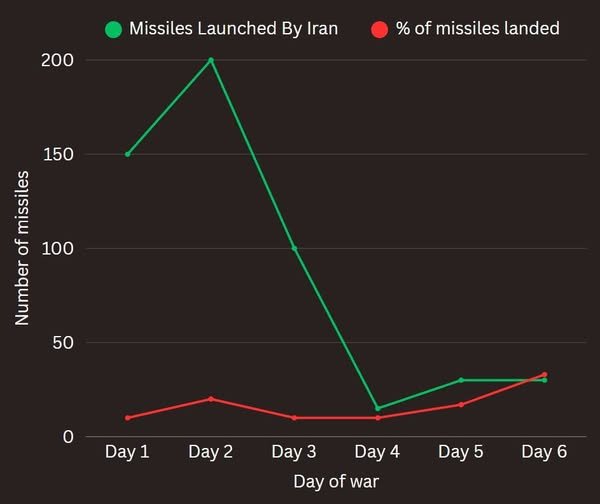
ON FEBRUARY 28, THE WAR STARTED IN TEHRAN.
TODAY, THE WAR IS EVERYWHERE EXCEPT TEHRAN.
That is not an accident.
That is the strategy.
When America and Israel bombed Tehran on February 28, the plan was simple.
Strike the leadership. Collapse the command structure. The regime falls. The war ends.
It did not end.
Instead, something calculated happened.
Iran moved the war.
Within days, the world stopped talking about Tehran.
- Suddenly everyone was talking about Hormuz.
- Then Bab al-Mandeb.
- Then Hezbollah firing rockets into Israel from Lebanon.
- Then Iraqi militias launching nearly 1,000 drones at Saudi Arabia, up to half of them from inside Iraq, targeting the Yanbu oil hub on the Red Sea.
The UAE absorbed 2,819 incoming drones and missiles. Kuwait's civilian airport was struck. US soldiers were killed at Camp Buehring.
Five simultaneous fronts. None of them Tehran.
America cannot bomb Iraq for what Iran ordered from Tehran.
It cannot bomb Yemen for what Iran funded from Qom.
It cannot bomb Lebanon for what Iran built in 1982.
Every time the pressure lands on one front, Iran opens another. The center of gravity keeps moving.
And every time it moves, Tehran breathes easier.
.
.
.
Iran did not invent this strategy. They perfected it.
The Soviet Union used the exact same playbook in Vietnam.
America was fighting North Vietnamese soldiers.
Behind them, the USSR was supplying weapons, advisers, and strategic direction without a single Soviet boot on the ground.
Washington could bomb Hanoi.
It could not bomb Moscow.
The Soviets bled America for a decade from thousands of miles away and never officially entered the war.
America then turned around and used the identical strategy in Afghanistan in the 1980s.
The CIA funded and armed the Afghan mujahideen through Pakistan.
Moscow was fighting Afghan guerrillas carrying American weapons.
The war bled the Soviet economy for ten years and contributed directly to the collapse of the USSR.
The weapon that destroyed a superpower was not American soldiers.
It was the strategy of forcing an enemy to fight everywhere except where you actually are.
Iran studied both wars carefully.
Here is what Iran built over 40 years.
In 1982, Iran sent 1,500 IRGC trainers into Lebanon.
They built Hezbollah — now the world's most heavily armed non-state military force.
In Iraq after 2003, they cultivated Kataib Hezbollah and Asaib Ahl al-Haq, militias that answer to Tehran, not Baghdad.
In Yemen, they armed the Houthis until they could fire ballistic missiles at Riyadh and close the Bab al-Mandeb.
Not an army. A network.
Distributed. Deniable. Dispersed across six countries.
You can kill the Supreme Leader. They did.
You can bomb Natanz, Fordow, and Isfahan. They did.
But you cannot bomb Kataib Hezbollah out of Iraq without starting a new war in Iraq.
You cannot destroy the Houthis without invading Yemen. You cannot disarm Hezbollah without another Lebanon war.
This is the architecture Iran spent four decades building — specifically so no single strike on any single location could destroy it.
---
The most dangerous opponent is never the one who fights you directly.
It is the one who forces you to fight everywhere simultaneously, draining your resources, dividing your attention, exhausting your strength — while they sit at the center and wait.
The Soviet Union learned this in Afghanistan.
America learned it in Vietnam.
The world is learning it again right now.