Russian General Mocks US Military

In a stinging critique of Western military power, Andrey Kartapolov, a senior Russian lawmaker and retired Colonel General, publicly dismissed the operational effectiveness of the United States military on March 28, 2026. Kartapolov, who serves as the Chairman of the State Duma Defense Committee, claimed that the U.S. lacks the planning depth and "tactical maturity" forged by Russia’s sustained combat operations in the 2020s.

His remarks come at a time of heightened global tension, with Kartapolov positioning the Armed Forces of the Russian Federation as the world’s sole leader in high-intensity, peer-level warfare.

Kartapolov’s primary argument centers on the difference between theoretical capability and modern battlefield experience. He asserted that the U.S. military has become overly reliant on air superiority and PR-driven narratives rather than complex ground maneuvers.

The Planning Gap: Kartapolov stated: "We clearly see today that Americans do not reach our capabilities in conducting operations at the tactical and operational level; they simply do not know how to plan them."

"Fly and Bomb": He characterized American military doctrine as simplistic, claiming, "All they can do is fly, bomb, and talk about how good everything is for them. We solve tasks differently."

The "Experience" Argument: The General argued that Russia’s "Special Military Operation" has provided its commanders with a "pattern-of-life" understanding of modern electronic warfare, drone integration, and artillery duels that the U.S. has not experienced in decades.

To support his claims of superiority, Kartapolov cited figures previously attributed to the Russian Ministry of Defense, painting a picture of an unstoppable military machine.

Equipment Losses: Kartapolov claimed Russian forces have destroyed nearly 8,000 tanks, 400 aircraft, and over 1,000 multiple-launch rocket systems (MLRS) since the start of the conflict in Ukraine.

State Recognition: He noted that over 120,000 Russian personnel have received state awards for valor, including more than 100 "Hero of Russia" titles, which he used as evidence of a "battle-hardened" officer corps.

While Kartapolov’s rhetoric is designed to bolster domestic morale and project strength abroad, independent data and open-source intelligence (OSINT) suggest a far more complicated reality.

Verified Losses: Data from the Oryx open-source community, which tracks visually confirmed equipment losses, tells a different story. As of late March 2026, visually confirmed Russian losses exceed 24,000 units (including over 3,000 tanks), significantly higher than the confirmed losses for Ukraine.

U.S. Modernization: While Kartapolov mocks U.S. "planning," the Pentagon has spent 2025 and 2026 rapidly integrating lessons from the Ukraine war into its own doctrine, specifically through the Replicator drone program and the deployment of F-35A fighters to strategic points like Misawa, Japan.

The Strategic Context: Analysts suggest Kartapolov’s comments are partly a response to the recent U.S.-Iran escalation and the US-Ukraine drone joint venture (Wilcox/General Chereshnya), which have showcased Western technological adaptability that Russia has struggled to match.

Andrey Kartapolov’s remarks represent the peak of Moscow’s "information warfare" strategy: portraying the West as a "paper tiger" that has forgotten how to fight on the ground. However, with the U.S. currently engaged in high-intensity operations in the Middle East and expanding its stealth and drone footprints globally, the General’s dismissal of American "planning" may be more of a defensive rhetorical shield than a battlefield reality.

Read More

Author: Saikat Bhattacharya

International geopolitics General Unipolar vs Multi-polar 04-April-2026 by east is rising

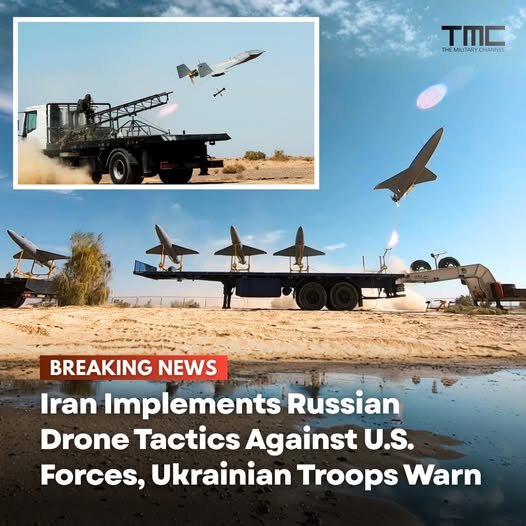
Iran Implements Russian Drone Tactics AgainSt USA

In a stark briefing at the German Marshall Fund on March 26, 2026, a delegation of Ukrainian military personnel delivered a chilling assessment: Iran is systematically adopting Russian drone warfare tactics to target U.S. assets in the Middle East. According to the visiting officers, the Iranian military has moved away from "existential" mass attacks, opting instead for a Russian-style strategy of dispersed attrition, a method refined during years of combat against Ukrainian defenses.

"Iran, North Korea, China, and Russia that's all one war," one Ukrainian officer told analysts and media. The warning highlights a growing technical and tactical "feedback loop" where Russian combat experience in Ukraine is being exported back to Tehran to counteract Western air defenses.

The Ukrainian delegation noted that Iranian tactics changed significantly between July 2025 and March 2026. Rather than launching large, easily detectable waves of drones, Tehran is now mirroring the Russian "drip" strategy.

Dispersion and Persistence: Instead of single, massive strikes, Iran is launching smaller groups of drones more frequently. This forces U.S. and partner defenses (such as Patriot and Iron Dome) into a state of permanent high alert, depleting expensive interceptors against low-cost targets.

Diversified Targeting: Echoing Russia's strikes on Ukrainian energy grids, Iran has expanded its target set to include civilian and economic infrastructure. By hitting "lower priority" targets, Iran imposes high political and economic costs on host nations without triggering a full-scale U.S. retaliatory strike.

Decentralized Command: Reports from the Institute for the Study of War (ISW) confirm that Tehran has decentralized its drone operations, instructing field commanders to "fire at will." This mirrors the Russian "autonomous cell" approach used to bypass centralized Electronic Warfare (EW) jamming.

Ukrainian intelligence indicates that the relationship between Moscow and Tehran has evolved from a simple hardware trade into a sophisticated tactical partnership.

Targeting Intelligence: Western intelligence officials recently reported that Russia is providing Iran with real-time targeting data, including the precise locations of U.S. warships and aircraft in the Middle East.

The "Geran" Evolution: While Iran originally provided the Shahed-136 to Russia, Moscow has since developed specialized variants including jet-powered versions and is now reportedly shipping these improved models back to Iran to test against American Aegis and Phalanx systems.

Feedback Mechanism: Russian advisors who observed Ukrainian EW signatures are reportedly helping Iran "harden" its drones against the specific frequency-hopping patterns used by U.S. military jammers in the Persian Gulf.

The visiting Ukrainians reiterated that the current U.S. and Gulf defense model is becoming economically unsustainable, a lesson learned painfully in Kyiv over the last four years.

The Interceptor Gap: Gulf states have recorded over 4,200 projectiles as of March 22, 2026. Firing $3.7 million Patriot missiles to shoot down $20,000 drones is a math problem that favors Iran in a prolonged conflict.

Ukrainian Expertise: In response, Ukraine has sent air-defense specialists to Saudi Arabia and other Gulf nations. They are introducing "interceptor drones" which cost as little as $1,000 as a cost-effective alternative to high-end missiles.

Untapped Capacity: Ukrainian officials emphasized that 60% of their drone-manufacturing capacity remains unused due to funding shortages. They are pitching a "triangular" partnership where Gulf funding fuels Ukrainian production to counter Iranian-Russian tactics across both theaters.

The "Russian-style" drone war has arrived in the Middle East. By adopting the tactics of attrition, persistence, and decentralized command, Iran is attempting to outlast Washington’s patience rather than defeat its military outright. For the U.S., the challenge is no longer just a technical one; it is an economic and logistical race. As the Ukrainian delegation warned, if the U.S. does not adapt to this shared playbook, it risks being bled dry by a thousand "cheap" cuts.


Read More

Author: Saikat Bhattacharya

International geopolitics General world order 04-April-2026 by east is rising

Alimony To Be Paid By Father In Law If Husband Dies

The Allahabad highcourt has observed that a husband's obligation to maintain his wife continues even after his death and the widow can claim maintenance from her father-in-law.

More details ????http://toi.in/_Aqblb

Read More

Author: Saikat Bhattacharya

Social Sex War feminism 04-April-2026 by east is rising