





Martin Ciupa
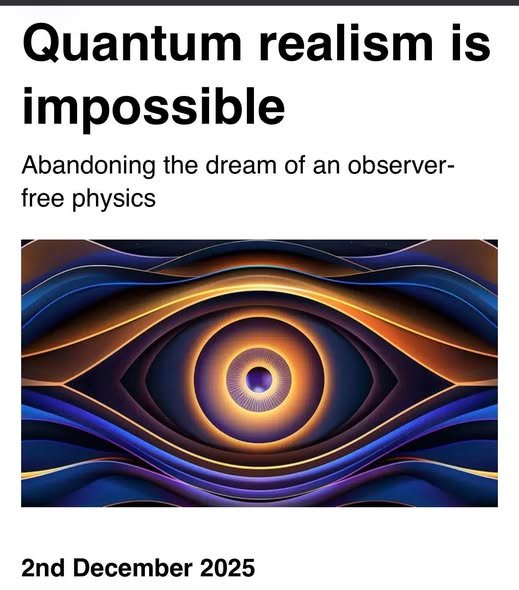
Quantum realism (ie., physical reality exists independently) is impossible — Abandoning the dream of an observer-free physics
The article is an interview with physicist Paul Davies, arguing that modern developments in quantum theory and quantum technology make it impossible to maintain a “realist” view of the universe in which reality exists independently of observation. Instead, Davies contends that measurement — observation — plays a constitutive role: quantum mechanics doesn’t just reveal reality, it helps bring it into being.
Main Points
• At its origin, quantum mechanics seemed to promise a description of reality at a fundamental level — beyond human perception. But over a century later, the core puzzle known as the Measurement problem remains unresolved.
• According to Davies, quantum uncertainty isn’t like classical randomness (e.g. a coin toss due to ignorance). Rather, the uncertainty is irreducible: even with complete information, quantum laws only provide probabilities, not certainties.
• As a result, quantum objects don’t have definite properties (like position) until they are measured. Before measurement, those properties simply do not exist in a definite form — the system is in a “blurred” superposition of possibilities.
• Thus, rather than discovering a pre-existing reality, quantum measurement “brings reality into being.” Reality is not a fixed backdrop, but is shaped — at least partially — by observation.
• The emergence of new quantum technologies (quantum computers, sensors, etc.) shows that we are no longer just theorizing: quantum phenomena have engineering applications. This transition from theory to engineering forces physicists to confront the ontological implications: if reality depends on measurement, what does that mean for our fundamental picture of the world?
• Davies argues that every attempt to “save” a traditional view — that reality exists independent of observers — has failed. He suggests that physics must now acknowledge that observation/measurement plays a foundational role in the structure of reality itself.
Conclusion / Significance
The piece challenges the deeply held intuition (rooted in classical physics and everyday experience) that the world has a definite structure independent of our observations. According to Davies, quantum mechanics — especially as it becomes practically applied — shows that this view may be untenable. Instead, reality may be intrinsically tied to observation: what we call “real” only takes definite form when we measure it. This has profound implications: not just for physics, but for our philosophical understanding of reality itself. By confronting the measurement problem head-on, Davies argues we must abandon naïve realism and accept that observers are part of what builds reality
Author: Saikat Bhattacharya